Youthful facial aesthetics are defined by smooth transitions, elevated cheekbones, soft contours, and well rounded structural volume. As time progresses, intrinsic aging, environmental exposure, and natural gravity cause gradual shifts in the subcutaneous architecture of the face.
The superficial and deep fat pads located within the cheeks, temples, jawline, and periorbital regions slowly deflate and migrate downward. This structural depletion creates shadow lines, hollowed under eye troughs, prominent nasolabial folds, and a flattened midface profile that can make individuals appear tired or older than their chronological age.
The Science Behind Facial Aging and Volume Loss
Facial aging is a complex, three dimensional process involving multiple anatomical layers including bone, muscle, fat compartments, and skin. During youth, fat pads are plump, closely juxtaposed, and supported by a robust bony foundation and resilient collagen network.
As decades pass, bone resorption occurs around the eye sockets, upper jaw, and jawline, diminishing the structural scaffold of the face. Simultaneously, facial fat compartments undergo atrophy, losing mass and shifting downward under gravitational pressure.
Why Facial Volume Changes Over Time
Facial appearance changes naturally with age, weight fluctuations, genetics, and the structure of the underlying tissues. The cheeks may appear less full, the temples can become hollow, and transitions between facial areas may look more pronounced. These changes are normal, but some people explore cosmetic treatments when they want to restore a fuller appearance.
Facial volume is only one part of facial appearance. Skin quality, bone structure, muscle movement, and natural asymmetry all influence the final look. A treatment that works well for one person may not produce the same effect for another, which is why an individual assessment matters.
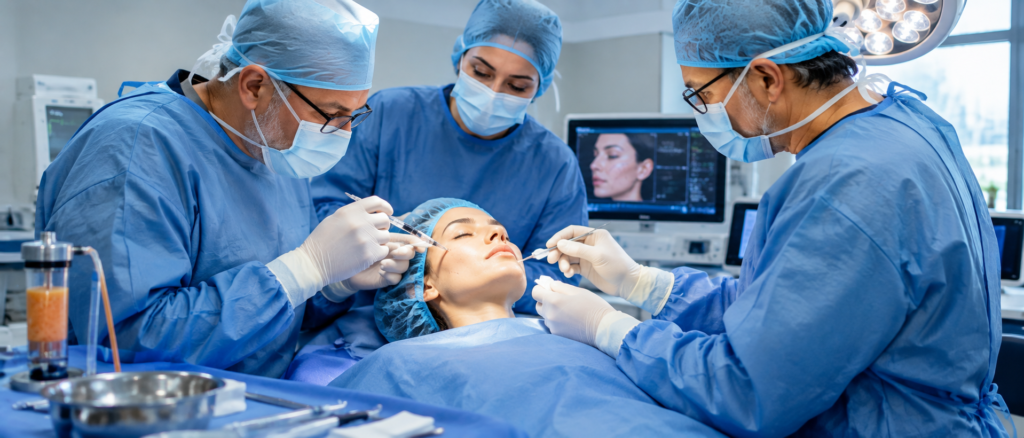
Fat transfer is one option used to restore selected areas of facial volume. It involves taking fat from another area of the body, processing it, and carefully placing it into the face. The aim is to improve contours while respecting the person’s natural features.
How Facial Fat Transfer Works
The procedure typically has three stages. First, a surgeon removes a small amount of fat from a donor area, often the abdomen or thighs, using a liposuction technique. The collected fat is then processed to separate suitable fat tissue from unwanted fluids and other material.
Next, the surgeon injects the prepared fat into selected facial areas using small instruments and careful placement. The amount and location depend on the person’s facial anatomy, the quality of available donor fat, and the desired degree of correction.
Not all transferred fat survives permanently. Some of it is naturally reabsorbed during healing, so the initial fullness may decrease over time. The final result develops gradually, and individual outcomes cannot be predicted with complete certainty.
How to Prepare for a Consultation
A useful consultation should cover your goals, health history, previous cosmetic procedures, medication use, and expectations. Tell the surgeon about allergies, bleeding problems, and any condition that may influence healing. Ask whether your donor area contains enough suitable fat and how the procedure would be adapted to your facial structure.
If you are considering facial fat transfer, ask how much volume is likely to be retained, when the result can be assessed, and whether further treatment might be needed. You should also discuss alternatives, likely downtime, the full cost, and the surgeon’s plan for managing complications.
Areas That May Benefit from Volume Restoration
Facial fat transfer may be considered for several areas, depending on anatomy and clinical suitability. The cheeks may be treated to improve fullness, while the temples can sometimes benefit from carefully planned volume restoration. Selected hollows or facial contours may also be assessed.
The goal is not to make every area fuller. Excessive volume can create an unbalanced appearance, so conservative planning is often important. A qualified surgeon evaluates how the proposed changes will relate to the forehead, cheeks, chin, and overall facial proportions.
Patients should also discuss whether fat transfer is appropriate for their particular concern or whether another treatment would be more suitable.
Fat Transfer Compared With Dermal Fillers
Fat transfer and injectable dermal fillers can both be used to address certain types of facial volume loss, but they differ in several ways. Fat transfer uses tissue taken from the patient’s own body, while most common fillers use manufactured substances designed for injection.
Fillers are often performed as office based treatments and may be adjusted or repeated according to the product used. Fat transfer involves a donor site and a more involved procedure, with recovery considerations for both the donor area and the face.
Neither approach is automatically right for everyone. The choice depends on the treatment area, medical history, desired degree of change, budget, and willingness to accept the risks and recovery involved.
What Influences the Final Result?
The outcome of facial fat transfer depends on several factors, including the surgeon’s technique, the quality of the harvested fat, the injection method, and individual healing. Smoking, certain medical conditions, and changes in body weight may also affect results or recovery.
Patients should understand that the amount of fat retained varies. A surgeon may recommend a conservative approach because placing too much fat at once can lead to irregularities or an unnatural contour. In some cases, an additional procedure may be discussed after the initial result has settled. It is helpful to evaluate results over time rather than judging the outcome while swelling is still present.
Recovery and Aftercare
Swelling and bruising are common after facial fat transfer. The donor area may also feel sore, swollen, or bruised following fat removal. Recovery time varies, and the surgeon will provide instructions tailored to the specific procedure.
During recovery, patients may need to:
- Avoid strenuous exercise until cleared by their surgeon.
- Follow instructions for cleaning and caring for treatment areas.
- Attend scheduled reviews so healing can be monitored.
- Avoid applying pressure to treated areas when instructed.
- Report unexpected changes or worsening symptoms promptly.
Temporary asymmetry may occur because swelling does not always develop evenly. Patients should follow medical guidance and avoid attempting to massage or manipulate the treated area unless specifically advised.
Risks to Understand Before Treatment
Fat transfer is a medical procedure, not a risk-free beauty treatment. Potential complications include infection, bleeding, persistent swelling, contour irregularities, fat absorption, asymmetry, and complications associated with anaesthesia or fat harvesting.
Rare but serious complications can occur when injected material enters a blood vessel. Depending on the area treated, vascular complications may cause tissue injury or vision-threatening problems. This is why appropriate training, anatomical knowledge, careful technique, and a suitable clinical setting are essential.
Seek urgent medical attention for sudden visual changes, severe or unusual pain, skin colour changes, or other symptoms that the clinical team identifies as warning signs.
Conclusion
Facial fat transfer offers one approach to restoring selected areas of facial volume using a person’s own fat. Its suitability depends on anatomy, medical history, expectations, and acceptance of the procedure’s risks and recovery requirements.
A careful consultation helps determine whether fat transfer, another treatment, or no procedure is appropriate. Understanding how results develop and why outcomes vary allows patients to make informed decisions based on their own needs rather than trends or unrealistic promises.
