Building a mobile application has become an important step for businesses looking to strengthen their digital presence, improve customer engagement, and introduce new revenue opportunities. However, developing an application entirely from scratch can require significant time, technical expertise, financial investment, and ongoing resources. For businesses that want to enter the digital market without managing every stage of development independently, white label app development offers a practical alternative.
White label applications allow businesses to use an existing software foundation, customize it according to their brand identity, and launch it under their own name. This approach can simplify the development process, reduce initial expenses, and help organizations bring digital products to market more quickly.
However, the success of this approach depends heavily on the development partner you choose.
Not every white label app development provider offers the same level of customization, technical quality, security, or long-term support. Choosing an experienced White Label App Development Company can help businesses access flexible solutions that offer greater customization, reliable technology, and seamless integration capabilities. Some companies provide ready-made solutions with limited flexibility, while others offer extensive customization options to meet specific business requirements and support long-term growth.
Choosing the wrong partner can lead to performance issues, unexpected expenses, limited scalability, and difficulties when your business needs to introduce new features.
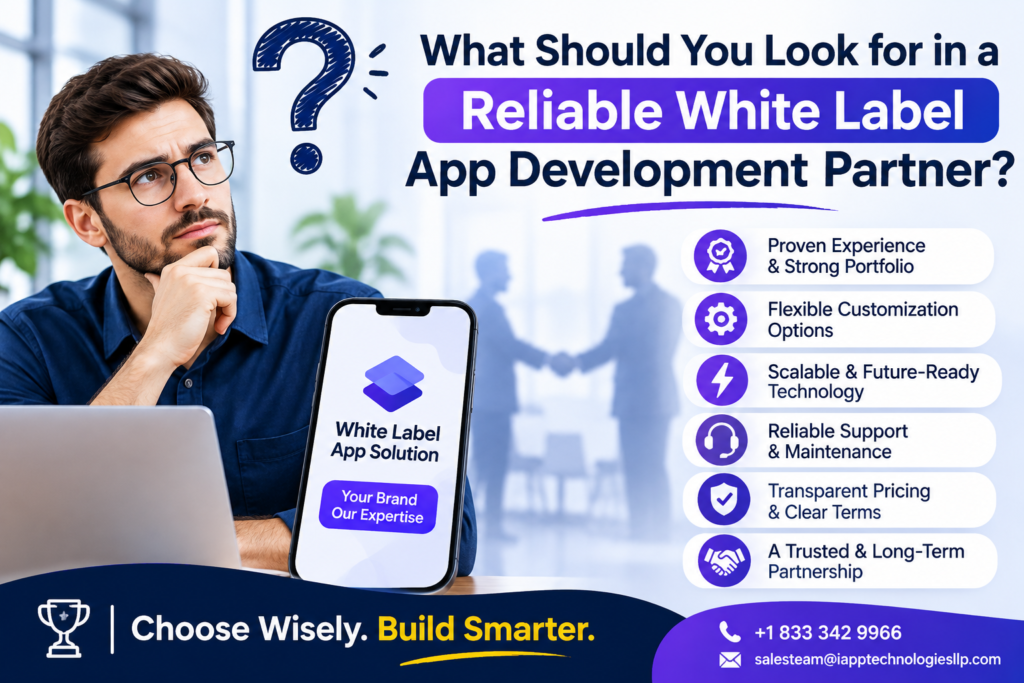
So, what should you look for when selecting a reliable white label app development partner?
Let’s explore the essential factors that can help you make an informed decision and establish a strong foundation for your digital business.
1. Understand Your Business Requirements Before Choosing a Partner
Before approaching any white label app development company, take time to understand your business objectives and application requirements.
Different businesses need different types of applications. An e-commerce company may require product catalogs, payment integrations, and order tracking, while a fitness business may prioritize subscription management, workout tracking, and personalized dashboards.
Similarly, a restaurant may need online ordering and delivery management, whereas a service-based business may require appointment scheduling and customer communication tools.
Having a clear understanding of your requirements will help you identify a development partner that offers relevant experience and suitable technology.
Start by identifying:
- Your target audience and intended market.
- The main purpose of your mobile application.
- Essential features required for launch.
- Branding and customization expectations.
- Required integrations with existing business systems.
- Your initial development budget.
- Expected user growth and future expansion plans.
You should also decide whether you need an Android application, an iOS application, or a solution that supports both platforms.
A clear project scope makes it easier to compare development proposals and understand whether a white label solution can genuinely support your business objectives.
2. Evaluate the Company’s White Label Development Experience
Experience is one of the most important factors when choosing a development partner.
Although many software companies offer mobile application development, white label development involves specific requirements that go beyond building a conventional application.
A reliable provider should understand how to work with reusable application architectures, customizable interfaces, configurable features, third-party integrations, and brand-specific requirements.
For example, a company developing white label applications for multiple businesses should know how to maintain separate branding, configurations, and user experiences without compromising the stability of the underlying software.
Ask potential partners about their previous white label projects and the industries they have served.
Look for experience in areas such as:
- White label mobile application development.
- Custom application branding.
- Multi-tenant software architecture.
- API and third-party integrations.
- Cloud-based application development.
- Application deployment and maintenance.
It is also useful to understand whether the company develops its own white label software or primarily resells solutions created by another provider.
This distinction can influence how much control the company has over customization, technical improvements, and troubleshooting.
The right partner should be able to explain its development approach and demonstrate how its experience relates to your project.
3. Check the Quality of Their Portfolio and Previous Work
A development company’s portfolio provides a practical understanding of its technical and design capabilities.
Rather than relying only on marketing descriptions, examine the applications it has already developed.
Look for examples that demonstrate:
Design quality: Are the interfaces modern, consistent, and easy to navigate?
Customization capabilities: Can the company adapt application layouts, colors, logos, and features according to different business requirements?
Functional reliability: Do the applications perform smoothly without unnecessary delays or navigation problems?
Platform compatibility: Does the company have experience with Android, iOS, and different device configurations?
Industry knowledge: Has it worked with businesses that have requirements similar to yours?
If possible, download some of its publicly available applications and explore their functionality.
Pay attention to onboarding, navigation, loading speed, account management, and the overall user experience.
You can also request case studies explaining how the company addressed specific client requirements.
For example, if a development partner helped a retail business launch a branded shopping application, ask how it handled product catalog customization, payment integration, inventory synchronization, and application performance.
A strong portfolio should demonstrate more than attractive screens. It should show that the company can deliver practical software solutions that support real business operations.
4. Examine Customization and Branding Capabilities
Customization is one of the main reasons businesses choose white label app development.
Although the underlying software may already exist, your application should still reflect your company’s identity, services, and customer expectations.
A reliable development partner should offer flexibility in customizing the application without requiring unnecessary changes to its entire architecture.
Important customization areas include:
- Business logos and brand colors.
- Typography and visual elements.
- Application layouts and navigation.
- Homepage and dashboard design.
- Feature availability.
- User registration and onboarding.
- Notification preferences.
- Content and promotional sections.
For example, two businesses using the same white label platform may have completely different customer experiences.
A healthcare service provider may require a clean interface with appointment booking and patient communication features. An online retail business may need product discovery, shopping carts, and order tracking.
The development partner should be able to configure the application according to these differences.
You should also clarify which customizations are included in the standard package and which require additional development fees.
This helps avoid situations where a solution appears affordable initially but becomes expensive once branding and business-specific functionality are introduced.
5. Evaluate the Technology Stack and Application Architecture
Technology selection has a direct impact on application performance, maintenance, integration capabilities, and future growth.
A professional white label app development company should use reliable technologies and maintain an architecture that can accommodate changing business requirements.
The right technology combination depends on the application’s complexity, performance requirements, integrations, and expected user volume.
More importantly, understand how the underlying software is structured.
For example, a multi-tenant architecture can allow different businesses to operate through a shared software foundation while maintaining separate configurations and appropriate data boundaries.
However, the development company should explain how it isolates customer information, manages permissions, and handles customized functionality.
Ask about software updates, database management, API documentation, and the ability to migrate or extend the application in the future.
A reliable technical foundation reduces the chances of your business becoming dependent on an inflexible platform.
6. Prioritize Scalability and Future Business Growth
An application that works well for a small customer base may face difficulties when user numbers, transactions, and data requirements increase.
This is why scalability should be evaluated before selecting a white label development partner.
Consider whether the company offers:
- Scalable cloud infrastructure.
- Database optimization.
- Flexible backend architecture.
- API-based integrations.
- Performance monitoring.
- Support for increasing user volumes.
- Modular feature expansion.
For example, an online business may initially launch its application in one city and later expand into multiple regions.
As the business grows, it may require additional languages, payment options, delivery integrations, and customer management capabilities.
A scalable white label solution should provide a practical way to introduce these changes.
Ask the development company how its infrastructure handles increased traffic and what additional resources may be required as your application expands.
The objective is to select a platform that supports your current requirements while leaving room for future development.
7. Make Application Security and Data Privacy a Priority
Security should never be treated as an optional feature, particularly when your application handles customer accounts, personal information, payments, or business records.
White label applications may serve multiple businesses through shared infrastructure, which makes appropriate data separation and access management especially important.
A reliable development partner should follow established security practices throughout the development lifecycle.
Important security considerations include:
Secure authentication: Protect user accounts through suitable login and authentication mechanisms.
Data encryption: Safeguard sensitive information during transmission and storage.
Access controls: Ensure that users and administrators can access only the information and functions they are authorized to use.
Secure APIs: Protect communication between the mobile application, backend services, and external platforms.
Regular security updates: Address vulnerabilities and maintain software dependencies.
Backup and recovery: Establish procedures for protecting business information and restoring services when necessary.
Privacy requirements should also be considered according to the markets where your application operates.
For example, businesses serving European customers may need to consider GDPR requirements, while Canadian operations may need to assess applicable federal and provincial privacy legislation.
Ask the company whether it conducts security testing, performs code reviews, and maintains documented data protection practices.
If multiple clients use the same platform, specifically ask how their information is separated and protected.
8. Review Third-Party Integration Capabilities
Modern business applications rarely operate independently.
They often need to communicate with payment gateways, CRM systems, inventory platforms, marketing tools, analytics services, and other external applications.
A white label app development partner should have experience integrating third-party services through APIs and other supported integration methods.
For example, an e-commerce application may require integration with:
- Payment processing services.
- Inventory management systems.
- Shipping and delivery platforms.
- Customer relationship management software.
- Email marketing services.
- Analytics tools.
A healthcare booking application may need appointment management, calendar synchronization, and secure communication integrations.
Before selecting a company, identify the external systems your application needs to connect with.
Ask whether these integrations are supported by the existing platform or require additional development.
You should also clarify whether third-party service subscriptions, API usage fees, and maintenance costs are included in the quotation.
Strong integration capabilities can make your application more useful while reducing manual work across business operations.
9. Understand the Pricing Structure and Total Cost of Ownership
Pricing is another important consideration when evaluating white label app development partners.
One of the biggest advantages of white label solutions is the possibility of reducing initial development expenses. However, the advertised package price does not always represent the total cost of operating the application.
Some companies charge a one-time customization fee, while others use monthly subscriptions, annual licensing, or usage-based pricing.
Before signing an agreement, understand the complete pricing structure.
Consider the following expenses:
- Initial white label software licensing.
- Application customization and branding.
- Additional feature development.
- Android and iOS deployment.
- Backend hosting and infrastructure.
- Third-party integration fees.
- Ongoing maintenance.
- Technical support.
- Software upgrades.
For example, a solution with a low initial price may include limited customization and charge separately for important integrations.
Another provider may have a higher upfront cost but offer more functionality and ongoing support.
Instead of comparing only the initial quotation, calculate the expected cost over the first two or three years.
Ask for a written breakdown of all recurring and additional expenses.
Transparent pricing makes financial planning easier and reduces the possibility of unexpected charges.
10. Evaluate Communication and Project Management
A successful white label application requires cooperation between your business team and the development partner.
Even if the underlying software is already available, customization, testing, integrations, and deployment still require proper project coordination.
A company with poor communication can create delays, misunderstandings, and unnecessary rework.
Before selecting a provider, understand how it manages projects.
Ask these questions:
- Will you receive a dedicated project manager?
- How frequently will progress updates be shared?
- Will you have access to a project management platform?
- How are customization requests handled?
- Who will coordinate technical discussions?
- How are unexpected delays communicated?
A transparent company should provide a clear implementation plan with defined responsibilities and milestones.
For example, the project may be divided into requirement analysis, branding, customization, integrations, testing, and deployment.
Regular reviews help ensure that the application is developing according to your expectations.
Good communication is not simply about responding quickly. It is about understanding requirements, explaining technical decisions, and keeping the project moving in the right direction.
11. Check Their Testing and Quality Assurance Process
Even when a white label platform has already been developed, customized applications require thorough testing before launch.
Branding changes, feature configurations, API integrations, and platform updates can introduce unexpected issues.
A professional development partner should have a structured quality assurance process.
Important testing activities include:
Functional testing: Ensuring that application features work correctly.
Compatibility testing: Checking application behavior across supported devices and operating systems.
Performance testing: Evaluating loading speed, responsiveness, and stability.
Security testing: Identifying potential vulnerabilities and access control issues.
Integration testing: Confirming that external services communicate correctly with the application.
Usability testing: Checking whether users can complete important activities without confusion.
Ask whether the company provides testing reports and how it manages bug fixing before deployment.
You should also request access to a test version of the application so your team can review the actual experience.
A dependable quality assurance process can prevent technical issues from affecting customers after launch.
12. Look for Reliable Post-Launch Support and Maintenance
Launching an application is only the beginning of its operational journey.
Once your application becomes available to users, it will need regular updates, technical monitoring, troubleshooting, and improvements.
Operating systems change, third-party services introduce updates, security requirements evolve, and customer expectations continue to develop.
Your white label development partner should offer dependable post-launch support.
Check whether the company provides:
- Bug fixing and troubleshooting.
- Operating system compatibility updates.
- Server and database monitoring.
- Security patches.
- Performance optimization.
- Feature upgrades.
- Technical assistance.
- Backup and recovery support.
It is also important to understand the support agreement.
Ask about response times, maintenance schedules, service-level agreements, and additional charges for support outside standard working hours.
Another important question is whether software updates are automatically applied to your application or require separate approval.
This is particularly relevant when multiple businesses share the same underlying white label platform.
You should understand how updates are tested and whether customized features will continue working after platform upgrades.
13. Confirm Source Code Access and Intellectual Property Rights
Ownership and control are often overlooked when businesses choose white label development services.
Before entering into an agreement, understand exactly what your company owns and what it is licensed to use.
In many white label arrangements, the provider retains ownership of the underlying platform while granting customers permission to use and customize it under agreed terms.
However, ownership of custom-developed features, branding assets, and other deliverables may vary.
Clarify the following:
- Who owns the original application source code?
- Who owns custom-developed features?
- Can your business access the application code?
- Are design files and documentation included?
- Can you transfer the application to another hosting provider?
- What happens if you terminate the agreement?
- Are there restrictions on using another development company?
These details should be documented in the contract.
Also clarify ownership and access rights for domain names, cloud accounts, application store accounts, and third-party service subscriptions.
A clear agreement protects your investment and helps prevent long-term vendor dependency.
14. Assess the Company’s Reputation and Client Feedback
A development company’s reputation can provide valuable insight into its reliability and working standards.
Before making your decision, review customer testimonials, independent reviews, and available case studies.
Look for feedback about:
- Project delivery timelines.
- Quality of customization.
- Technical expertise.
- Communication.
- Pricing transparency.
- Problem resolution.
- Long-term maintenance.
Do not rely entirely on testimonials displayed on the company’s website.
Explore independent review platforms and, where possible, request references from previous clients.
You can also ask the development company how it handles difficult situations, such as integration failures, unexpected requirements, or performance problems.
A reliable partner should be willing to explain its working process and demonstrate how it supports clients beyond the initial launch.
15. Why a Long-Term Technology Partnership Matters
Choosing a white label app development partner should not be treated as a one-time purchasing decision.
Your application may need new features, integrations, design improvements, and infrastructure upgrades as your business grows.
A development company that understands your business objectives can provide more consistent technical support over time.
For example, an organization launching a basic customer booking application may eventually need loyalty programs, automated notifications, payment integrations, and advanced analytics.
Working with a partner that understands the existing architecture can make these improvements easier to plan and implement.
A long-term partnership can also improve communication, reduce the time needed to understand project requirements, and support more effective product planning.
However, businesses should avoid becoming unnecessarily dependent on a single provider.
Maintain access to important documentation, understand your licensing rights, and establish clear exit arrangements.
The ideal relationship combines ongoing technical collaboration with sufficient business control and flexibility.
Conclusion
Choosing a reliable white label app development partner requires more than comparing package prices or reviewing attractive application designs.
You need a company that understands your business objectives, offers dependable technology, provides meaningful customization, and supports your application throughout its lifecycle.
From technical architecture and data security to third-party integrations, scalability, and post-launch maintenance, every factor contributes to the overall quality of your digital product.
Before making a final decision, evaluate the company’s experience, review its portfolio, understand its pricing model, and carefully examine ownership and support agreements.
Most importantly, choose a development partner that sees your application as a long-term business investment rather than simply another software delivery project.
White label app development can help businesses reduce development complexity, accelerate market entry, and establish a stronger digital presence. However, the real value comes from selecting a solution that can adapt to your requirements and grow alongside your business.