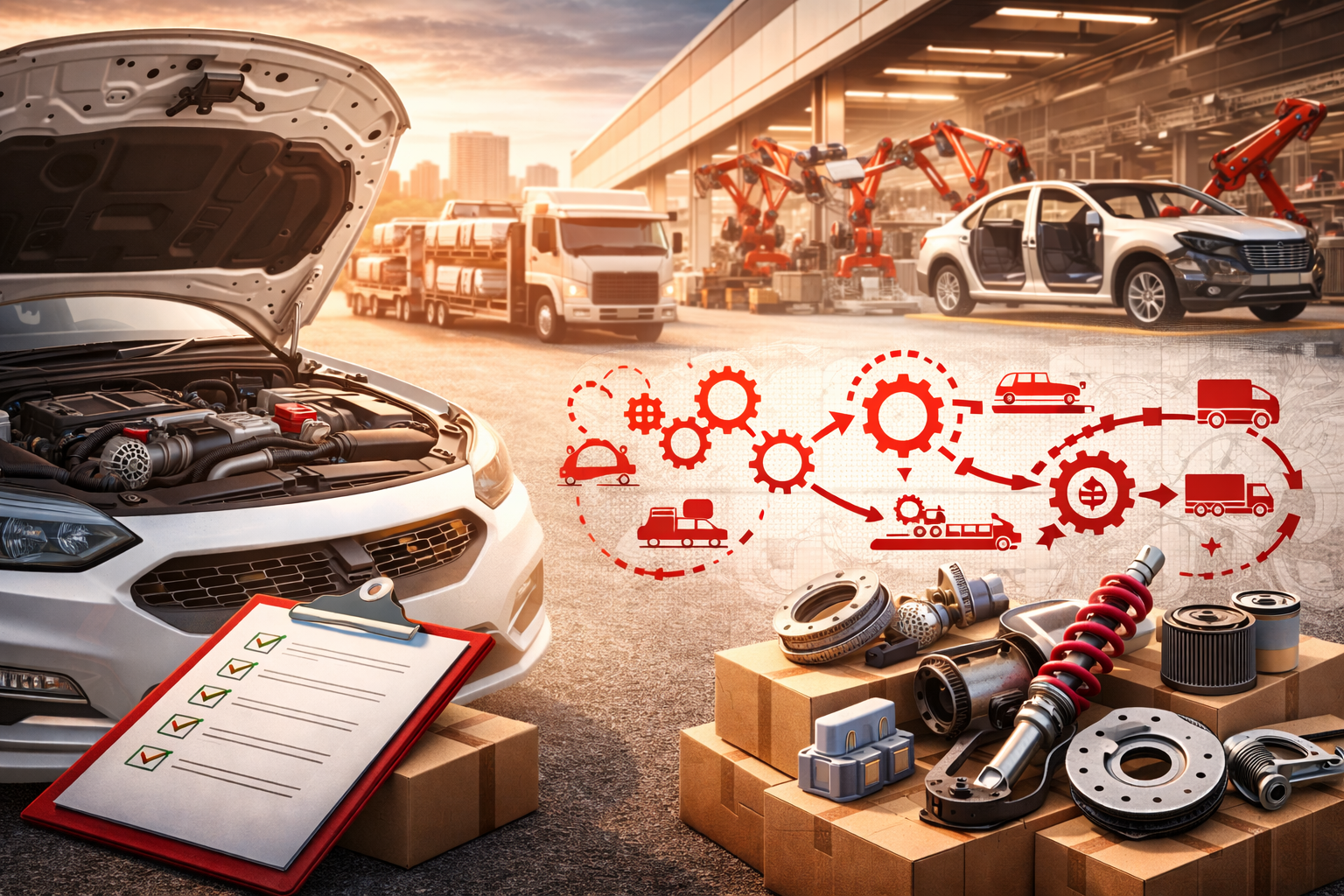
An auto supply chain strategy is the structured plan automotive manufacturers use to control sourcing, suppliers, inventory, logistics, and risk so vehicles are produced and delivered without disruption. In 2026, a winning auto supply chain strategy must prioritize resilience, digital visibility, supplier diversification, cost efficiency, and production continuity — not just lean operations.
Automotive supply chains are global, complex, and highly interdependent. One delayed component can stop an entire assembly line. That is why strategy now determines competitiveness. This guide explains how to build a supply chain system that protects production, reduces risk, and strengthens margins.
What Is an Auto Supply Chain Strategy and Why It Matters
An auto supply chain strategy is the long-term operational framework that connects raw material sourcing, multi-tier suppliers, manufacturing plants, inventory systems, and vehicle distribution networks into one coordinated structure. It defines how parts are sourced, how risks are managed, how inventory is positioned, and how vehicles move from factory to dealership.
It matters because Automotive Parts Freight Management or production depends on thousands of synchronized components. A shortage of semiconductors, EV batteries, or electronic modules can shut down production entirely. A structured strategy ensures full supplier visibility, integrated forecasting, transportation planning, and contingency preparation — all working together to prevent disruption.
Core Pillars of a Winning Auto Supply Chain Strategy
A strong auto supply chain strategy is built on five pillars: visibility, resilience, cost control, flexibility, and digital integration. These pillars must function as one system rather than isolated improvements.
Key structural components include:
- Multi-tier supplier transparency
- Dual sourcing for critical components
- Integrated demand forecasting
- Balanced inventory models
- Transportation network optimization
- Real-time data platforms
- Structured risk monitoring
When these elements align, manufacturers reduce downtime, improve delivery reliability, and protect profitability.
Supplier Network Strategy: Managing Tier 1, Tier 2 and Tier 3 Risk
Automotive supply chains rely on layered supplier ecosystems. Tier 1 suppliers deliver complete systems directly to manufacturers, while Tier 2 and Tier 3 suppliers provide subcomponents and raw materials. Many disruptions originate at lower tiers where visibility is limited.
A winning strategy maps the entire supplier network — not just direct vendors. Companies must evaluate geographic risk, production capacity, financial health, and regulatory compliance across all tiers. Dual sourcing and regional diversification reduce dependency on single markets. Continuous supplier performance tracking ensures early detection of delays or quality issues before they escalate into shutdowns.
Inventory Strategy: Balancing Lean Efficiency with Resilience
Just-in-time production once defined automotive efficiency. However, recent global disruptions exposed its limitations. In 2026, the most stable manufacturers use a hybrid model.
Critical, long-lead, or globally sourced components require calculated safety stock levels. Predictable, locally sourced parts can remain under lean systems. Advanced forecasting tools determine where buffers are necessary and where lean flow remains efficient. The goal is strategic positioning of inventory — not excess accumulation.
This balance protects production continuity without dramatically increasing carrying costs.
Transportation & Logistics Optimization
Transportation plays a direct role in production timing and dealer delivery performance. Automotive logistics includes inbound materials, plant transfers, and outbound finished vehicle distribution.
An optimized transportation structure focuses on:
- Multi-modal planning (road, rail, ocean)
- Route optimization systems
- Carrier performance monitoring
- Real-time shipment tracking
- Consolidation and cross-docking hubs
Efficient logistics reduces delays, lowers cost per vehicle, and increases overall supply chain reliability through Advanced Transportation Management Systems.
Digital Transformation: The Backbone of Modern Auto Supply Chain Strategy
Digital visibility is now the foundation of any effective auto supply chain strategy. Without real-time data, companies react to disruptions instead of preventing them.
Modern systems integrate Track and Trace Logistics, AI forecasting, IoT tracking sensors, ERP and SCM platforms, predictive analytics, and supplier dashboards. These tools provide live updates across procurement, inventory, and transportation. Early risk detection allows manufacturers to adjust production schedules, reroute shipments, or activate alternative suppliers before disruptions spread.
Digital integration turns supply chains from reactive networks into proactive systems.
Risk Management and Resilience Planning
Automotive supply chains operate in a volatile global environment. Geopolitical tensions, raw material shortages, and regulatory changes create constant uncertainty. A winning strategy includes documented contingency plans and scenario modeling.
Manufacturers must identify single-source dependencies, diversify manufacturing regions, maintain alternative supplier contracts, and test crisis-response procedures regularly. The objective is operational continuity — even during unexpected events.
Resilience is no longer optional. It is a strategic requirement.
Sustainability and Regulatory Compliance
Environmental regulations and investor expectations are reshaping automotive operations. A modern auto supply chain strategy must incorporate emission reduction, ethical sourcing, and compliance transparency.
Optimized transport routes reduce carbon output. Responsible raw material sourcing — particularly for EV batteries — strengthens compliance. Transparent documentation across supplier tiers protects manufacturers during audits and strengthens brand trust.
Sustainability now influences competitiveness and long-term growth.
Key KPIs That Define Strategy Success
Strategy must be measurable. Automotive companies should consistently monitor:
- On-time supplier delivery rate
- Production downtime frequency
- Inventory turnover ratio
- Logistics cost per vehicle
- Supplier defect rate
- Order fulfillment accuracy
Tracking these metrics enables continuous improvement and early detection of structural weaknesses.
How to Build an Auto Supply Chain Strategy (Step-by-Step)
Building a winning auto supply chain strategy begins with full supplier network mapping and vulnerability analysis. The next step is integrating forecasting and digital visibility tools. Companies then redesign inventory positioning for high-risk components, optimize transportation contracts, diversify sourcing regions, and formalize resilience planning. Finally, performance metrics must be tracked continuously to refine the system over time.
This structured implementation ensures long-term stability rather than temporary improvements.
Final Takeaway
An auto supply chain strategy in 2026 must balance efficiency with resilience. Lean systems alone are no longer enough. Manufacturers that combine digital visibility, diversified sourcing, optimized logistics, and proactive risk management build stable production environments and protect profitability.
In today’s automotive industry, supply chain strength determines competitive advantage. Companies that treat strategy as a core business function consistently outperform those that treat it as a back-end operation.
If you want next-level optimization, N can now tighten this further for featured snippet dominance or convert it into a pillar-page structure.
