Most composter reviews focus on the same three things: price, appearance, and how fast it runs. Those things matter, but they’re not what determines whether you’ll still be using the machine six months from now. The details that shape daily satisfaction, including filter replacement costs, what the output actually is, noise levels during sleeping hours, and whether the capacity matches your household, rarely make the headline. And yet, these are the factors that turn a promising purchase into either a daily kitchen habit or an appliance that collects dust behind the coffee maker.
Here’s what to actually evaluate before choosing the best countertop composter for your kitchen.
Capacity vs. How Your Household Actually Eats
The spec sheet lists capacity in liters. What matters more is pounds per day. A couple producing light scraps can work comfortably with a 2–3 liter unit. A family of four that cooks daily generates enough peels, eggshells, plate scrapings, and leftovers to need 4 liters or more.
Running a half-empty machine wastes energy. Overfilling creates incomplete processing. The goal is matching the composter to your actual daily output, not your aspirational use. Also worth asking: does the machine accept mid-cycle additions, or do you have to wait for a full cycle to finish before adding more scraps? That distinction can affect how the composter fits into your cooking routine.
What the Output Actually Is (And Isn’t)
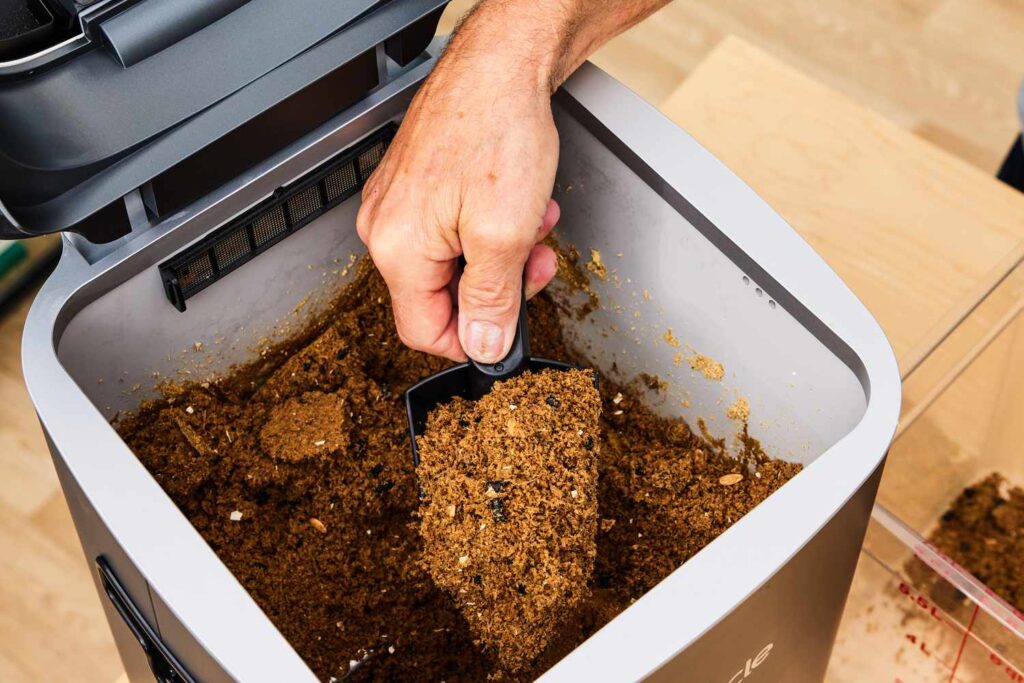
This is where most reviews fall short. The material that comes out of a countertop food composter is not traditional compost. Depending on the machine and the mode it runs, the output is either dehydrated ground food scraps or a partially matured soil amendment with active microbial life.
Dehydrated output needs further composting; weeks in an outdoor pile or worm bin, before it benefits plants. A biologically active soil amendment, on the other hand, can go directly into garden soil or potting mix.
The single question that separates these two categories: does the machine just dry and grind, or does it support actual microbial breakdown during processing? That answer tells you more about the value of the output than any marketing claim.
Ongoing Costs Most Buyers Don’t Calculate
The purchase price is one number. The annual cost of ownership is another. Before buying, factor in the recurring expenses that show up after month one:
- Activated carbon filters: Replaced every 2–4 months, depending on the brand; typically $15–$30 per replacement
- Microbial tablets or additives: Some machines require them per cycle or monthly; others need none
- Electricity: Most countertop composters draw 300–500 watts and run for 4–24 hours per cycle
- Proprietary vs. standard parts: Some brands offer branded refills; others use standard carbon
Add 12 months of maintenance to the sticker price. That’s the real number to compare.
Noise, Odor, and the Things You Live With Daily
A composter rated at 45 dB sounds fine on paper. But if it runs overnight in an open-concept apartment, that number feels different from what it would in a closed-off kitchen. Noise peaks during the grinding phase and drops during heating. If you’re sensitive to sound, look for machines under 45 dB and plan to run cycles during waking hours.
Odor control depends entirely on filter quality and replacement frequency. A fresh carbon filter handles everything. A neglected filter turns any machine into a problem. Set a reminder when you install a new one, and swap it before you notice a smell.
These aren’t glamorous specs, but they determine whether the composter becomes a daily habit or a countertop decoration you eventually unplug.
The Question That Narrows the Field Fastest
If the options feel overwhelming, start with one question: What do you want to do with the output?
If you just want less trash and a lighter garbage bag, a basic dehydration machine handles that. If you want something for your houseplants, garden beds, or lawn that adds nutrients and biological life to the soil, you need a machine with microbial processing capability.
Start there. Once you know what you need the output to do, the rest of the specs fall into place, and the best countertop composter for your household becomes a much shorter list.
