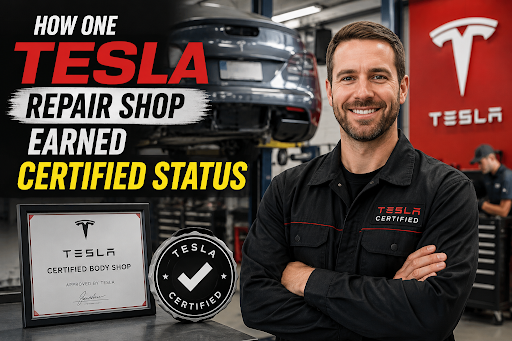
Earning certification as a collision repair facility is not a milestone every shop can reach — and that gap is wider than most people realize. Tesla’s program carries a reputation for prestige, but behind it sits an exhaustive set of infrastructure demands that quietly eliminate the majority of shops before a single form is submitted. For vehicle owners seeking a Tesla-certified body shop, that distinction is not trivial. It directly affects repair quality, warranty integrity, and the long-term structural safety of the vehicle.
Most Auto Body Shops Never Make It Past the First Requirement
Tesla publishes its certification requirements. Any shop owner can read them. The problem is that reading the list and meeting it are separated by years of operational investment most facilities have never made.
The dominant misconception is that an established collision shop — one with strong reviews, experienced technicians, and a full equipment bay — can pursue Tesla certification with a round of targeted upgrades. That assumption collapses at the first infrastructure audit.
The real filter is not the application. It is the inventory of what a shop already has versus what Tesla’s program actually demands. Most shops exit at this stage. Not because the requirements are unreasonable, but because the baseline they expose is far below what the certification assumes. The gap between shops that express interest and shops that complete certification is not a matter of motivation. It is a matter of infrastructure readiness that no quick-fix investment can substitute.
The Tooling Wall: Equipment That Most Shops Cannot Justify Buying
Tesla mandates an aluminum MIG welding system — specifically pulse MIG capability. The standard steel MIG setup that handles most collision work is an immediate disqualifier. Aluminum and steel behave differently under heat, require different wire feeds, and demand separate contamination controls. A technician trained on steel cannot transfer that skill to aluminum without dedicated retraining, and the equipment cannot be shared between the two.
Tesla also requires a dedicated aluminum repair zone — not a partitioned corner of an existing bay, but a physically separated workspace with contamination protocols that prevent steel particles from migrating into aluminum repair areas. For shops in facilities not built with this separation, reconfiguration costs can exceed the equipment investment itself.
Frame measuring and structural pulling systems must meet Tesla’s OEM-specific standards. A standard lift that satisfies state inspection requirements does not qualify. Tesla’s audit requires certified diagnostic-grade structural systems, and the cumulative capital threshold across compliant welding, workspace, and structural equipment runs well into five figures before a single Tesla is touched.
Shops that had already invested in aluminum repair infrastructure for high-end European imports — BMW, Audi, Mercedes — entered this process with a structural advantage. That was not coincidence. It was prior strategic positioning in a segment that demanded the same precision Tesla now requires.
Why Used or Off-Brand Equipment Gets Flagged Immediately
Tesla’s audit cross-references equipment serial numbers against manufacturer certification records. A welder that meets generic OSHA safety thresholds but lacks the manufacturer certification Tesla specifies is a flagged item, not a compliant one. Shops that attempt to bridge the gap with off-brand or secondhand alternatives discover this at the audit stage — after the time and administrative effort of the application process has already been spent.
The Training Requirement Most Shops Underestimate
I-CAR Platinum certification is Tesla’s baseline credential for participating technicians. Platinum status requires a sustained commitment to role-specific training hours, maintained across the team — not held by one lead technician while others remain at a lower tier.
The assumption that certifying one person satisfies the requirement is among the most common miscalculations shops make. If that technician leaves, the shop’s compliance posture changes. Tesla certification introduces a retention and workforce planning dimension that most collision facilities have never managed before.
High-voltage safety training is a separate, non-negotiable layer. Technicians working near Tesla battery systems must be qualified for live high-voltage environments — a fundamentally different risk category from internal combustion engine repair. The liability exposure of placing an unqualified technician near a live battery pack during diagnostics or structural work is significant. Shops that treat this as a secondary item typically discover it is a primary requirement mid-application.
For shops that underinvested in technician development, the training requirement proves as obstructive as the tooling wall — sometimes more so, because equipment can be purchased faster than credentials can be earned.
The Certification Timeline Nobody Talks About
Tesla certification is not a one-time audit event. It is an ongoing compliance posture. Lapsed training credentials or equipment changes can trigger decertification. A shop that earns certification and then allows I-CAR Platinum status to lapse risks losing the designation it spent months and significant capital to achieve. For shops that maintain it, sustained certification signals consistent operational discipline — not a historical achievement, but a live standard being met on an ongoing basis.
What Spectrum Auto Did Differently
Spectrum Auto’s path to becoming a Tesla-authorized body shop did not begin with Tesla. It began years earlier with the decision to invest in aluminum repair infrastructure to service high-end European imports in Rockland County. That prior investment — dedicated aluminum workspace, pulse MIG capability, certified structural systems — meant the gap between Spectrum’s existing setup and Tesla’s requirements was narrow rather than prohibitive.
I-CAR Platinum commitment at Spectrum predated the Tesla certification pursuit. It was a foundational hiring and training standard, not a reactive credential scramble. High-voltage safety training was integrated into technician onboarding before it became an industry talking point.
The certification process did not transform Spectrum Auto. It validated operational standards that were already above the regional baseline. A Tesla-certified body shop that built toward certification from a position of existing strength carries a different operational profile than one that retrofitted the minimum requirements to pass an audit.
What This Means for EV Owners in Rockland County and the Hudson Valley
The tooling and training gap translates directly into a shortage of qualified repair options in most markets. The certified shop pool for Tesla-authorized body shop services in the Hudson Valley and Rockland County region is small. For Tesla owners in West Nyack, Cortlandt, Montrose, and Wurtsboro, geographic proximity to a certified facility is not a convenience factor — it is a practical constraint when structural repair cannot be deferred.
Choosing a certified shop is not a preference. It is a warranty-compliance and structural safety decision. Repairs performed outside the certified network can affect OEM warranty coverage and may not meet Tesla’s structural repair standards for a vehicle carrying passengers at highway speed.
Spectrum Auto Inc.: Built for the Standard Tesla Demands
Certification does not happen by accident. It happens because a shop spent years building the infrastructure, training the team, and maintaining standards that certification programs eventually require. Spectrum Auto Inc. did exactly that. From aluminum repair capability to I-CAR Platinum technician credentials to high-voltage safety training, every element Tesla’s program audits was already in place. For Tesla owners across Rockland County and the Hudson Valley, that means access to a repair facility that did not adjust to meet the bar — it was already above it. Visit Spectrum Auto Inc. to schedule your Tesla repair consultation.
Frequently Asked Questions
- What specific equipment does a shop need before applying for Tesla certification?
Tesla requires an aluminum-capable pulse MIG welding system, a dedicated aluminum repair zone physically separated from steel work areas, and a certified diagnostic-grade frame measuring and structural pulling system. Generic or off-brand alternatives that meet standard safety codes but lack manufacturer certification are flagged during the audit and treated as non-compliant.
- Why do most shops fail to complete the Tesla certification process?
Most shops exit before the formal application stage because their existing infrastructure does not meet Tesla’s baseline. The capital investment required for compliant welding equipment, workspace reconfiguration, and certified structural systems — combined with the staff training commitment — exceeds what most facilities have budgeted or built toward.
- Does I-CAR Platinum certification apply to the whole shop or just one technician?
Tesla’s requirement applies across the participating technician team, not a single designated lead. If a Platinum-certified technician leaves, the shop’s compliance status is affected. This workforce retention dimension is one of the most underestimated operational challenges in pursuing and maintaining Tesla certification long-term.
- Can a Tesla-certified shop service other EV brands, or is the certification brand-specific?
Tesla certification is specific to Tesla vehicles and does not extend to other EV brands by default. However, the infrastructure it requires — aluminum repair capability, high-voltage safety training, precision structural systems — directly supports high-quality repair work on other electric vehicles. A shop that has met Tesla’s standards is operationally ahead of most competitors for the broader EV repair market.
