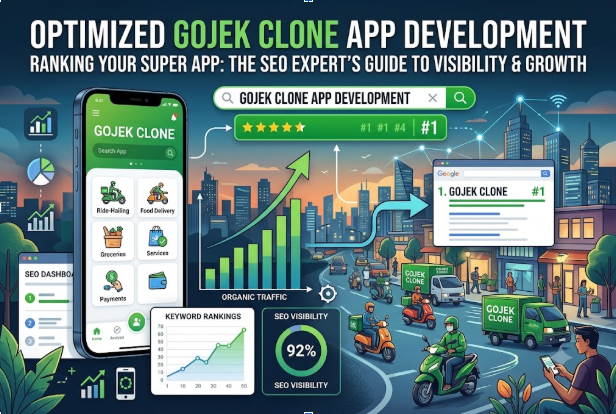
If you’ve spent any time researching super-app business models, you’ve probably run into the same name over and over: Gojek. What started as a ride-hailing service in Indonesia turned into a platform that handles rides, food delivery, courier services, groceries, and payments, all under one roof. Naturally, entrepreneurs everywhere want a piece of that success, and that’s exactly why Gojek clone app development has become such a popular route into the on-demand economy in 2026.
So what does building a Gojek clone app actually involve, and is it still a smart move this year? Let’s break it down.
What Is a Gojek Clone App, Really?
A Gojek clone app isn’t a copy-paste job of the original platform. Think of it more as a proven framework that mirrors Gojek’s core structure — three connected apps for the customer, the service provider, and the admin — all built around a multi-service marketplace. Developers take that structure and customize it around your branding, your service categories, your target city, and your payment gateways. The result is a platform that behaves like Gojek but is shaped entirely around your business.
This matters because building a super app from scratch can take a year or more and burn through serious capital. A clone-based approach compresses that timeline dramatically, which is a big reason so many founders lean on this model instead of starting with a blank slate.
Why 2026 Is a Good Year for This Model
The on-demand economy hasn’t slowed down, it’s just gotten more specific. Customers now expect one app to handle multiple needs: book a ride, order lunch, send a package, and pay a bill, all without switching platforms. Regional super apps are popping up across Southeast Asia, the Middle East, Africa, and Latin America because local entrepreneurs understand their markets better than any global giant does.
AI-driven dispatching, smarter fraud detection, in-app wallets, and real-time analytics are now standard expectations rather than nice-to-haves. Any solid development partner in this space should be building these features in from day one, not bolting them on later.
Core Features You’ll Need
A functional multi-service platform typically needs the following pieces working together smoothly:
● Customer app: service browsing, live tracking, in-app chat, multiple payment options, ratings, and promo codes
● Provider app: job requests, earnings dashboards, route optimization, and availability toggles
● Admin panel: service management, commission control, provider verification, analytics, and dispute resolution
Beyond the basics, think about what makes your platform distinct. Maybe it’s a specific service vertical, like grocery, home repairs, or laundry, a loyalty program, or hyperlocal features tailored to a particular city’s traffic patterns and payment habits. The clone gives you the skeleton; these choices give it a personality.
Choosing the Right Development Approach
There are generally three paths for building this kind of platform: buying a pre-built script and customizing it lightly, working with an agency on a semi-custom clone solution, or going fully custom while still borrowing the proven multi-service architecture. Your choice depends on budget, timeline, and how differentiated you want your platform to be.
A pre-built script is the fastest and cheapest option but offers the least flexibility. A semi-custom build, which is what most serious founders choose, strikes a balance between a tested foundation and room to add unique features. Fully custom development gives maximum control but requires the biggest budget and the longest timeline.
Whichever route you pick, vet your development partner carefully. Ask to see previous multi-service apps they’ve shipped, not just ride-hailing or food delivery in isolation. Building a true super app requires experience juggling multiple service types inside one consistent user experience, and that’s a different skill than building a single-purpose app.
Budget and Timeline Expectations
Costs vary widely depending on features, platforms (iOS, Android, web), and the region of the development team. A basic version with core ride and delivery features can be launched in roughly two to three months. A more feature-rich platform with multiple service verticals, advanced admin tools, and custom UI/UX typically takes four to six months.
Rather than fixating on the lowest quote, focus on what’s included: post-launch support, scalability, and how easily new services can be added later without a full rebuild.
Common Mistakes to Avoid
Founders often rush the planning phase and jump straight into development, which usually backfires. Skipping proper market research, underestimating the importance of a smooth onboarding flow for service providers, and ignoring local payment preferences are among the most frequent missteps in these projects.
Another one worth flagging: treating the admin panel as an afterthought. It’s the backbone of daily operations, handling commission tracking, dispute resolution, and provider approvals, and it deserves as much attention as the customer-facing app.
Final Thoughts
Launching a multi-service platform in 2026 is more achievable than ever, thanks to mature, feature-rich frameworks that have already solved the hardest architectural problems. Choosing Gojek clone app development lets you focus your energy on what actually matters for your business — your market, your branding, and your service quality — rather than reinventing the technical wheel.
If you’re serious about entering the super app space, take time to define your niche, choose a development partner with real multi-service experience, and plan your budget around long-term scalability rather than just the initial launch. Do that, and you’ll be in a strong position to build something that genuinely serves your local market.
