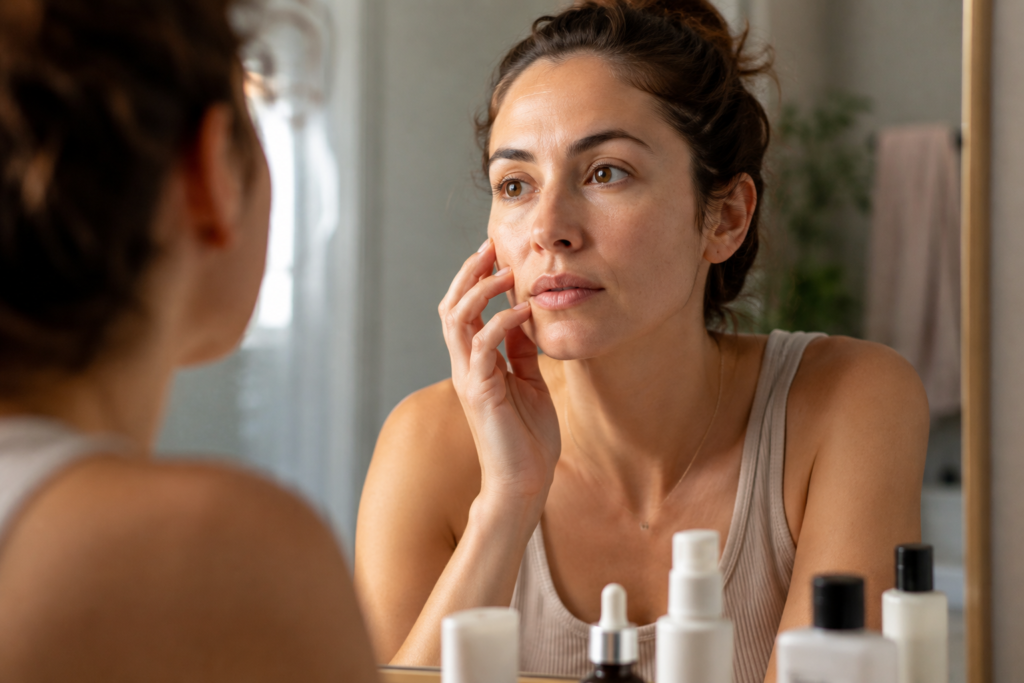
Turning 30 does not automatically mean you need to start using retinol. Retinol can be useful for concerns such as fine lines, uneven pigmentation, texture and photoaging, but age alone is not a reason to add it to a routine. If your skin is sensitive or you deal with rosacea or eczema, tolerance matters even more. In other words, there is no “30th birthday deadline” for retinol. The better question is whether you have a skin concern you want to address and whether your skin can comfortably tolerate a retinoid.
Do You Need Retinol at 30?
The short answer is no. There is no universal rule that everyone should use retinol after turning 30. Retinol is one type of retinoid, a family of vitamin A-derived ingredients used in skincare. Dermatologists commonly discuss retinoids for concerns such as mild acne, pigmentation irregularities and fine lines, but whether one makes sense depends on the person’s skin and goals. The American Academy of Dermatology explains the difference between retinoids and retinol, and it also recommends discussing retinoid use with a dermatologist when significant redness or inflammation is present.
What Can Retinol Actually Do for Your Skin?
There is good evidence that topical retinoids can improve signs of photoaging, although the strength of evidence differs between prescription retinoids and cosmetic retinol. A systematic review of randomized controlled trials found consistent improvements in photoaging with topical tretinoin, including wrinkling and uneven pigmentation. A one-year controlled study of 0.1% stabilized retinol also found improvements in several measures of photodamaged skin. That does not mean every retinol product will produce the same results, but it does explain why retinol has earned a place in many anti-aging routines.
Is Retinol Suitable for Sensitive Skin?
This is where the answer becomes more personal. Retinol can cause dryness, peeling, redness or stinging, particularly when someone is new to retinoids. Sensitive skin may have less room for trial and error, so starting aggressively is usually a poor strategy. More irritation is not a sign that a product is working better.
If you are considering a retinoid, introduce only one new active at a time, follow the product directions and start at a frequency your skin can tolerate. Keep the rest of your routine simple and use a moisturizer to support hydration. If you want to compare traditional retinol with other retinoid options for easily irritated skin, this guide to the best retinol for sensitive rosacea skin is a useful next read.
What About Retinol if You Have Rosacea or Eczema?
Retinol and Rosacea
Rosacea changes the conversation because the skin can be unusually sensitive and easily irritated. The American Academy of Dermatology recommends gentle, fragrance-free skincare for rosacea and emphasizes avoiding products or habits that trigger irritation. These rosacea-friendly skin-care recommendations are worth reviewing before adding another active ingredient. If you have active redness, burning, frequent flares or an uncertain diagnosis, it makes sense to ask a dermatologist whether a retinoid belongs in your routine.
Retinol and Eczema
Eczema is another reason not to treat retinol as a one-size-fits-all ingredient. Eczema-prone skin benefits from a gentle routine and consistent moisturizing, and new products can sometimes trigger irritation. The AAD recommends eczema-friendly skin care such as fragrance-free moisturizers and careful introduction of new products. If your eczema is actively flaring, adding a potentially irritating active is something to discuss with a healthcare professional rather than simply pushing through discomfort.
I Don’t Have Wrinkles Yet. Should I Start Anyway?
Not necessarily. Having no visible wrinkles at 30 is not a reason to start retinol out of fear that you are “late.” Skincare is not a race. If you are happy with your skin and your routine already supports your goals, there is no requirement to add another active. Retinol may become more relevant if you want to address a particular concern such as uneven texture, pigmentation, acne or early signs of photoaging.
Can You Use Retinol With Vitamin C?
The idea that retinol and vitamin C automatically “react badly” together is too simplistic. They are not inherently incompatible ingredients. There is even clinical research evaluating regimens that use retinol and vitamin C together. One clinical study of a retinol and vitamin C facial regimen reported improvements in several measures of photodamaged skin, although the study was small and open-label.
For someone with sensitive skin, the more practical issue is irritation. You do not need to use every popular active at the same time. Keeping the routine manageable can make it much easier to see what your skin actually tolerates.
What Does “2% Retinol” Actually Mean?
This is worth checking carefully before buying a product simply because the label says “2% retinol.” A percentage on a skincare product needs to be interpreted in the context of the actual formulation. Do not automatically assume that “2%” means 2% pure retinol, and do not assume that a higher percentage is automatically better for sensitive skin.
The same principle applies to a retinol moisturizer. A product can provide hydration while also delivering a retinoid, but calling it a moisturizer does not make the retinoid component automatically gentle. Look at the complete ingredient information, follow the manufacturer’s directions and consider how your skin normally reacts to active ingredients.
How to Start Retinol if You Have Sensitive Skin
• Start when your skin is relatively calm. Do not use a new active as an experiment during a significant flare.
• Introduce it gradually. There is no need to jump straight into nightly application.
• Use the amount and frequency recommended for the product. More product does not mean faster results.
• Keep the rest of the routine gentle. Avoid introducing several new exfoliants or actives at the same time.
• Moisturize regularly. This is especially important if your skin tends to become dry or irritated.
• Increase frequency only if your skin is tolerating the product comfortably.
• If you develop significant or persistent burning, redness, peeling or worsening of an existing skin condition, stop and seek professional advice.
And if your goal is to protect against photoaging, daily broad-spectrum sunscreen remains a basic part of the routine. For rosacea in particular, the AAD recommends broad-spectrum SPF 30 or higher and emphasizes year-round sun protection.
A Simple Routine for Sensitive Skin
Morning: Gentle cleanser if needed → vitamin C if tolerated → moisturizer → broad-spectrum sunscreen.
Evening: Gentle cleanser → retinol if appropriate and tolerated → moisturizer.
That is enough. A complicated routine is not automatically a better routine, particularly when your skin is prone to irritation.
The Bottom Line: Should You Use Retinol at 30?
If you are 30 and do not have wrinkles, you do not need to start retinol simply because of your age. If you have a specific reason for wanting a retinoid, it can be a useful ingredient, but sensitive skin calls for a slower and more careful approach. Rosacea and eczema add another layer of caution, especially when symptoms are active. Vitamin C is not automatically incompatible with retinol, and a “2% retinol” label should be interpreted carefully rather than treated as proof that a product is stronger or better.
The best skincare routine is not necessarily the one with the most active ingredients. It is the one that addresses your goals while your skin can comfortably tolerate it.
Sources & Further Reading
American Academy of Dermatology — Retinoid or retinol?
PubMed — One-year topical stabilized retinol treatment
PubMed — Topical tretinoin for treating photoaging: systematic review
American Academy of Dermatology — 7 rosacea skin care tips
American Academy of Dermatology — Atopic dermatitis skin care
