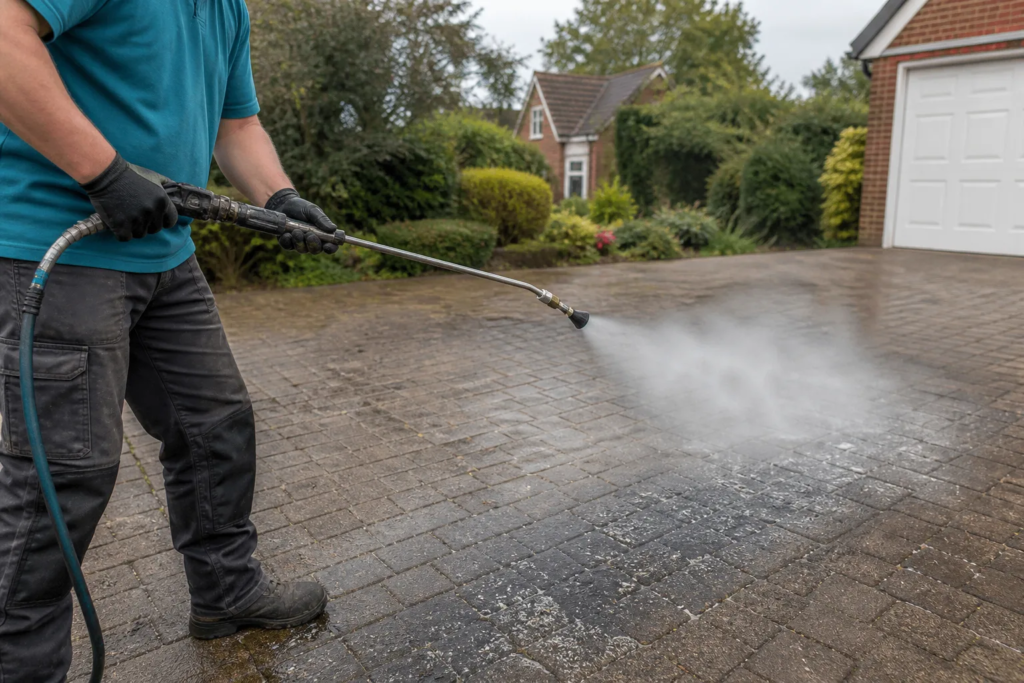
If your driveway is covered in moss, algae, dirt or weather stains, you may be wondering whether pressure washing or soft washing is the safer and more effective option.
There isn’t one method that’s right for every driveway.
The best choice depends on what your driveway is made from, its current condition, the type of dirt or organic growth present, and how the cleaning will affect the surface and joints.
This matters particularly in the UK, where regular rain, damp conditions, shade, falling leaves and winter weather can encourage moss and algae to return.
Pressure Washing vs. Soft Washing: What’s the Difference?
The simplest distinction is how each method does the cleaning.
Pressure washing relies mainly on water pressure to physically remove dirt, moss, algae and other surface contamination.
Soft washing uses a suitable cleaning solution to break down or treat organic growth, followed by low-pressure rinsing.
Neither approach is automatically better.
| Pressure washing | Soft washing |
| Relies on mechanical water pressure | Relies more on cleaning treatment |
| Effective against heavy surface dirt | Particularly useful for organic growth |
| Can provide immediate visible results | Can be gentler on vulnerable surfaces |
| Higher risk if excessive pressure is used | Requires appropriate chemicals and application |
| Can disturb loose jointing | Less mechanical impact on joints |
| Well suited to many durable surfaces | Useful where aggressive pressure isn’t appropriate |
The important question is therefore not “Which method is strongest?”
It’s “Which method is suitable for my driveway?”
When Is Pressure Washing the Better Option?
Pressure washing can be a good choice when the driveway is structurally sound and has substantial surface contamination.
It is often effective for removing:
- Ground-in dirt
- Mud
- General grime
- Surface algae
- Loose moss
- Weather-related staining
Concrete and some well-maintained block-paved driveways can tolerate controlled pressure effectively.
However, pressure should never be treated as a case of “more is better.”
Excessive pressure can damage surfaces, remove jointing material between paving blocks or create uneven cleaning marks.
A professional driveway pressure washer should be used with the appropriate pressure, nozzle, distance and technique for the particular surface.
When Is Soft Washing More Appropriate?
Soft washing can make more sense when moss, algae or other biological growth is the main problem.
Rather than relying entirely on high-pressure water, a suitable cleaning solution is used to treat the contamination before the surface is rinsed.
This can be useful where:
- The surface is more delicate
- There is extensive organic growth
- Block joints could be easily disturbed
- High pressure isn’t appropriate
- The problem requires treatment rather than simply surface removal
However, soft washing isn’t automatically safer in every situation.
The cleaning product itself must be appropriate for the driveway material and surrounding environment. Incorrect chemicals or poor application can cause staining, damage nearby plants or create other problems.
What About Block Paving?
Block paving is one of the surfaces where the difference between good and poor pressure washing becomes particularly noticeable.
The blocks themselves may be reasonably durable, but the joints between them can be vulnerable to aggressive cleaning.
If excessive pressure removes jointing material, the driveway may need additional work after cleaning.
For this reason, cleaning driveway bricks requires more than simply choosing a powerful machine.
The person carrying out the work should consider:
- The condition of the blocks
- The condition of the joints
- How firmly the blocks are bedded
- The amount of moss and algae
- Whether pressure can be safely used
If the driveway is heavily affected by moss, a combination of treatment and controlled pressure may be more appropriate than relying on maximum pressure alone.
What About Concrete?
Concrete is generally more tolerant of pressure washing than some other driveway materials.
A properly adjusted pressure washer can remove significant amounts of dirt, algae and surface grime.
But concrete isn’t indestructible.
Older concrete, cracked areas, exposed aggregate and surfaces showing signs of deterioration require greater care. High pressure may make existing damage worse or remove the surface layer.
Before professional driveway cleaning, the condition of the concrete should therefore be assessed rather than assuming the same pressure can be used everywhere.
What About Natural Stone?
Natural stone needs a more cautious approach because different stones can respond differently to pressure and cleaning products.
A method suitable for concrete may not be appropriate for every type of stone.
If your driveway contains natural stone, the cleaner should identify the material before deciding how it should be treated.
The objective should be to remove contamination while preserving the surface rather than simply achieving the strongest possible visual transformation.
Why UK Weather Matters
The UK’s weather can influence both the condition of the driveway and the timing of cleaning.
Spring
After months of wet and cold weather, moss and algae can become particularly noticeable.
Spring is often a useful time to assess the driveway and remove winter build-up before organic growth becomes more established.
Summer
Drier weather can provide better conditions for cleaning and drying.
If you are considering sealing after cleaning, a suitable period of dry weather is particularly important.
Autumn
Fallen leaves and organic debris can remain damp on the driveway for extended periods.
Regular removal can reduce the amount of organic material available to encourage moss and staining.
Winter
Cold, wet conditions make driveway maintenance more challenging.
Persistent rain can slow drying, while frost can affect already damaged surfaces. This doesn’t mean cleaning can never be carried out during winter, but weather conditions should influence the timing.
Does Pressure Washing Remove Moss Permanently?
No.
Pressure washing can remove existing moss, but it doesn’t permanently prevent new moss from growing.
Moss is more likely to return when the driveway remains damp, shaded or surrounded by organic debris.
The same applies to soft washing. Treating existing growth doesn’t mean the environmental conditions that caused it have disappeared.
This is why a good cleaning job should not be judged by whether the driveway remains completely moss-free forever.
The more realistic aim is to remove the existing growth effectively and keep the surface in good condition for as long as reasonably possible.
Should You Use Both Methods?
Sometimes, yes.
Pressure washing and soft washing don’t have to be competing alternatives.
A driveway with heavy moss and ingrained dirt may benefit from a combination of approaches.
For example, organic growth may first be treated with an appropriate solution, followed by controlled pressure cleaning to remove remaining dirt and debris.
The exact process should be determined by the surface and its condition.
Using two methods isn’t automatically better either. The right approach is the one that achieves the required result without exposing the driveway to unnecessary pressure or chemicals.
What Should a Professional Cleaner Assess First?
Before starting, an experienced driveway cleaning specialist should look at the surface rather than immediately switching on the pressure washer.
They should consider:
- What material is the driveway made from?
- Is the surface already damaged?
- Are the joints stable?
- Is the contamination mainly dirt, moss, algae or staining?
- How much shade does the driveway receive?
- Is water draining properly?
- Are there delicate areas that need different treatment?
This assessment is particularly important for residential driveway cleaning, because every property can have different surface conditions.
Pressure Washing or Soft Washing: Which Should You Choose?
Use pressure washing when your driveway is durable, structurally sound and mainly affected by heavy surface dirt or contamination that can be safely removed mechanically.
Consider soft washing when organic growth is the main concern or when the surface requires a gentler approach.
For some driveways, a carefully controlled combination of both may provide the most sensible result.
The deciding factor shouldn’t be the equipment a contractor happens to own. It should be the material, condition and type of contamination on your driveway.
The Bottom Line
Pressure washing isn’t automatically better because it is more powerful, and soft washing isn’t automatically better because it uses less pressure.
For UK driveways, the right method depends on the surface and the conditions it has been exposed to.
Block paving needs careful attention to its joints. Concrete can often tolerate controlled pressure but still needs assessment. Natural stone may require a more cautious approach. Moss and algae may benefit from treatment rather than pressure alone.
If you’re comparing driveway cleaning services, ask the cleaner to explain why they recommend a particular method for your surface.
The best result isn’t the driveway that was cleaned with the most pressure.
It’s the driveway that was cleaned effectively without unnecessary damage to the surface.