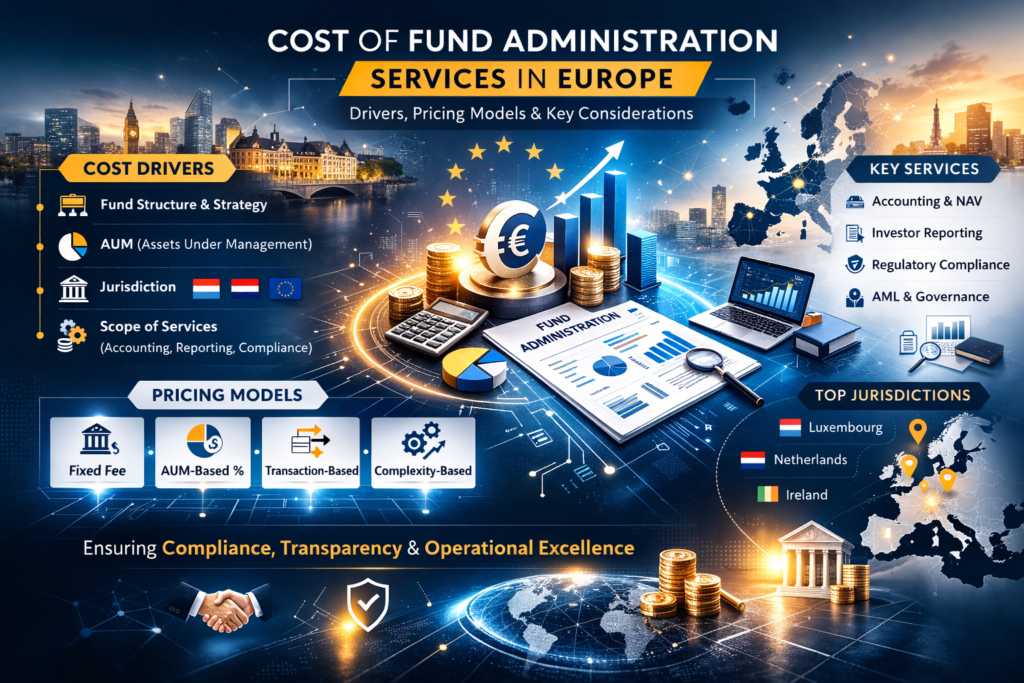
As Europe remains one of the world’s leading fund domiciles, understanding the cost of fund administration services is essential for asset managers launching or scaling investment vehicles. Whether operating in Luxembourg, the Netherlands, or other EU jurisdictions, administration costs vary depending on structure, complexity, and regulatory requirements.
What Drives the Cost?
Several key factors influence pricing:
1. Fund Structure and Strategy
Alternative investment funds, private equity vehicles, and cross-border UCITS structures require different levels of oversight. More complex structures typically increase operational workload and reporting obligations.
2. Assets Under Management (AUM)
Many providers price services based on AUM. As the fund grows, administrative fees may increase proportionally.
3. Jurisdiction
Costs can differ between fund domiciles. For example, fund administration Luxembourg services may carry pricing aligned with the country’s regulatory depth and global positioning as a cross-border hub.
4. Scope of Services
Basic accounting and NAV support will cost less than full-scope solutions that include investor reporting, regulatory filings, AML oversight, and governance support.
Typical Pricing Models
European providers usually structure fees in one of the following ways:
- Fixed annual fee (common for smaller or straightforward funds)
- AUM-based fee (percentage of assets)
- Transaction-based or complexity-based pricing
The choice of pricing model often depends on the scale and lifecycle stage of the fund.
Role of the Fund Administrator
A professional fund administrator handles operational tasks such as accounting, capital calls, distributions, and financial reporting. Their work ensures regulatory compliance and accurate investor reporting.
When comparing providers, managers often evaluate service scope, technology capabilities, experience in alternative assets, and regulatory knowledge. Choosing the best fund administrator is not only about cost but also operational reliability and long-term partnership value.
Comparing Providers Across Europe
There are numerous fund administration companies operating across Europe, ranging from boutique firms to global institutions. Larger providers are often recognised as top fund administrators due to their scale, automation capabilities, and multi-jurisdiction expertise.
However, smaller specialist firms may offer more personalised service or niche expertise in certain asset classes.
Balancing Cost and Value
While price is important, underestimating the importance of strong fund administration can create regulatory and operational risks. Accurate reporting, timely NAV production, and investor transparency are fundamental to maintaining trust.
Outsourcing to experienced fund administration services providers allows fund managers to focus on investment strategy while ensuring compliance and operational stability.
Cost of Fund Administration Services in Europe
The cost of fund administration services in Europe depends on fund structure, AUM, jurisdiction, and service scope. Rather than focusing solely on price, fund managers should assess long-term value, regulatory alignment, and operational expertise.
A well-chosen administrator supports scalability, compliance, and investor confidence, making it a strategic investment rather than just an operational expense.
