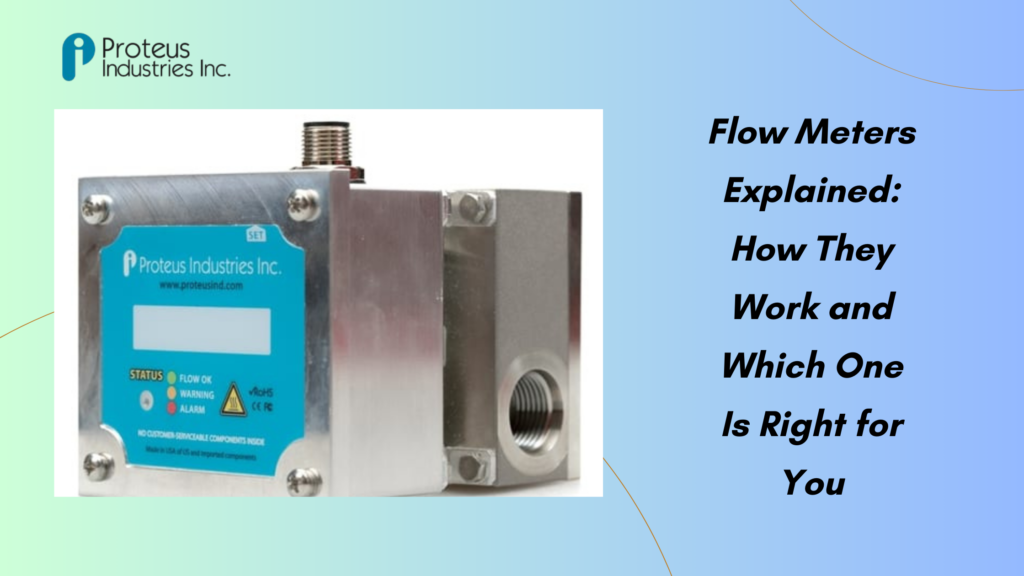
Every single day, industries around the world rely on one critical piece of equipment to keep their operations running safely, efficiently, and accurately. You might not think about it much — but without it, pipelines fail, processes go wrong, and costly mistakes happen.
That piece of equipment is the flow meter.
Whether you’re in manufacturing, water treatment, oil and gas, food processing, HVAC, or chemical production — flow meters are quietly doing one of the most important jobs in your entire system. And choosing the right one? That decision matters more than most people realize.
In this guide, we’re breaking it all down. What a flow meter actually is, how different types work, what industries use them, and most importantly — how to figure out which one is the right fit for your specific needs.
Let’s get into it.
What Is a Flow Meter?
A flow meter is a device that measures the flow rate of a liquid or gas moving through a pipe or system. It tells you how much of a substance is moving, how fast it’s moving, and in some cases, the total volume that has passed through over a given period of time.
That information sounds simple — but it’s incredibly powerful.
Knowing your exact flow rate allows you to monitor system performance, detect leaks, control processes with precision, ensure safety compliance, and make smarter decisions about energy and resource usage.
In short, a flow meter turns guesswork into data. And in any industrial or commercial setting, data is everything.
How Do Flow Meters Work?
This is where it gets interesting. High temperature flow meter don’t all work the same way. Different technologies are used depending on what’s being measured, the environment it’s being measured in, and the level of accuracy required.
Here’s a look at the most common types and how each one operates:
1. Turbine Flow Meters
One of the most widely used and trusted types, turbine flow meters work exactly as the name suggests. As fluid flows through the pipe, it spins a rotor or turbine inside the meter. The faster the fluid moves, the faster the turbine spins — and that rotation is converted into a flow rate reading.
Turbine flow meters are known for their accuracy, durability, and versatility. They work well with clean liquids and gases and are a popular choice across a wide range of industries.
2. Electromagnetic Flow Meters
Also called mag meters, these devices use a magnetic field and the principles of electromagnetic induction to measure flow. When a conductive liquid passes through the magnetic field, it generates a voltage — and that voltage is proportional to the flow velocity.
Electromagnetic flow meters are ideal for measuring water, slurries, and other conductive liquids. They have no moving parts, which means less wear and tear and lower maintenance requirements over time.
3. Ultrasonic Flow Meters
These meters use sound waves to measure flow. Ultrasonic signals are sent through the fluid at different angles, and the difference in travel time between signals moving with and against the flow is used to calculate velocity.
Ultrasonic flow meters are non-invasive, highly accurate, and can be used on a wide range of pipe sizes. They’re especially useful when you need measurement without interrupting the flow or cutting into the pipe.
4. Differential Pressure Flow Meters
One of the oldest and most proven flow measurement technologies, differential pressure meters work by creating a restriction in the flow path and measuring the pressure drop across it. The greater the flow rate, the greater the pressure difference.
These meters are simple, reliable, and cost-effective — making them a go-to choice for many standard industrial applications.
5. Vortex Flow Meters
When fluid flows past a bluff body inside the meter, it creates alternating vortices — similar to how wind swirls around a building. The frequency of these vortices is directly proportional to the flow velocity, giving you an accurate measurement.
Vortex flow meters are excellent for steam, gas, and liquid applications and are valued for their long-term reliability and low maintenance needs.
6. Coriolis Flow Meters
Considered among the most accurate flow measurement technologies available, Coriolis meters measure mass flow directly rather than volumetric flow. Fluid passes through vibrating tubes, and the Coriolis effect causes a measurable shift in the vibration — which is used to calculate mass flow rate and density simultaneously.
These meters are used in applications where precision is non-negotiable — pharmaceuticals, chemical processing, and custody transfer being prime examples.
What Industries Use Flow Meters?
The short answer — almost every industry that moves a liquid or gas through a pipe.
Water & Wastewater Treatment — Monitoring water supply, managing treatment processes, and ensuring accurate billing all depend on reliable flow measurement.
Oil & Gas — From upstream extraction to downstream distribution, flow meters are critical for custody transfer, leak detection, and process control.
Food & Beverage — Precise measurement of ingredients, cleaning fluids, and production outputs keeps quality consistent and waste minimal.
Chemical Processing — Accurate flow control is essential for safety, reaction efficiency, and product consistency in chemical plants.
Pharmaceuticals — In an industry where precision is everything, high temperature flow meter ensure exact dosing, mixing, and production quality.
HVAC & Building Management — Monitoring heating and cooling fluids improves energy efficiency and keeps systems performing at their best.
Manufacturing — From cooling water to hydraulic fluids, flow meters keep manufacturing processes running smoothly and safely.
How to Choose the Right Flow Meter
With so many options available, choosing the right flow meter can feel overwhelming. But it doesn’t have to be. If you ask the right questions, the decision becomes much clearer.
What are you measuring? Is it a liquid or a gas? Is it clean or does it contain particles or slurry? Is it corrosive, viscous, or conductive? The nature of your fluid narrows down your options significantly.
What level of accuracy do you need? Some applications require extremely precise measurement — custody transfer or pharmaceutical dosing, for example. Others can work with a good general approximation. Matching accuracy requirements to the right technology prevents overspending and underperforming.
What are your pipe size and flow range? Every flow meter has a range of pipe sizes and flow velocities it’s designed to handle. Choosing a meter outside its optimal range leads to inaccurate readings and premature wear.
What are the environmental conditions? Temperature, pressure, vibration, and the presence of chemicals in the surrounding environment all affect which meter will perform reliably over time.
What are your maintenance capabilities? Some meters have moving parts that require regular servicing. Others are virtually maintenance-free. Consider your team’s capacity and budget for ongoing upkeep before making a decision.
Do you need local display, remote monitoring, or both? Modern flow meters can integrate with digital systems, SCADA platforms, and remote monitoring setups. Think about how the data will be used and who needs access to it.
The Cost of Getting It Wrong
Choosing the wrong flow meter isn’t just an inconvenience — it can be genuinely costly. Inaccurate measurements lead to wasted resources, failed compliance checks, process inefficiencies, and in some cases, serious safety risks.
The right flow meter pays for itself through improved efficiency, reduced waste, and reliable performance that you can count on day after day. The wrong one? It costs you more in the long run — every single time.
This is why working with a knowledgeable, experienced flow meter provider isn’t optional. It’s one of the smartest investments you can make for your operation.
Find Your Perfect Flow Meter With Proteus Industries
At Proteus Industries, we’ve spent decades helping businesses across every major industry find the right flow measurement solution for their exact needs.
We don’t believe in one-size-fits-all answers. We believe in understanding your system, your fluid, your environment, and your goals — and then delivering a solution that performs reliably from day one.
Our range of high-quality flow meters is built for real-world industrial demands, backed by expert support, and designed to give you the accurate, dependable measurement your operation deserves.
Ready to find the right flow meter for your system? Contact Proteus Industries today — our team of experts is ready to help you choose, install, and get the most out of your flow measurement solution.
Because when measurement matters — and it always does — you deserve a partner who gets it right.
Proteus Industries — Precision You Can Count On, Every Flow of the Way.
