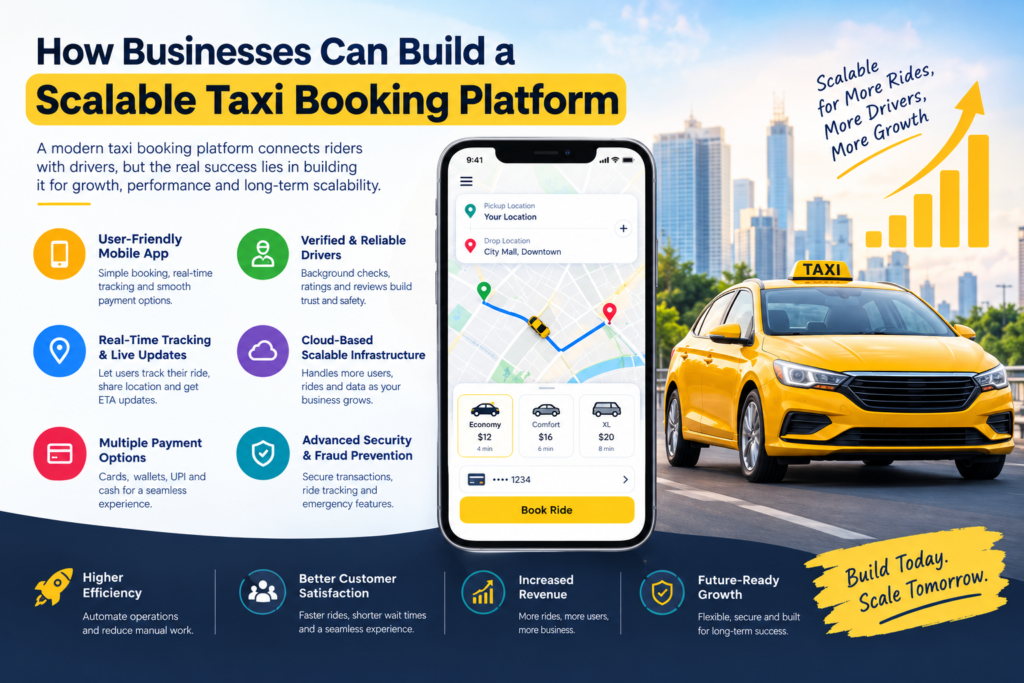
The taxi industry has moved far beyond traditional street hailing and phone-based bookings. Today, customers expect to book a ride within seconds, track drivers in real time, choose payment methods, receive accurate fare estimates, and manage their trips through a single mobile application. At the same time, taxi businesses need technology that can handle growing numbers of riders, drivers, bookings, and transactions without compromising performance.
This is where a scalable taxi booking platform becomes important.
Building a taxi booking solution is not simply about creating a passenger app with a booking button. A modern platform usually involves multiple connected systems, including a passenger application, driver application, admin dashboard, backend infrastructure, payment systems, maps and location services, notifications, analytics, and security mechanisms. Partnering with the Best taxi App Development company can help businesses bring these components together into a reliable, scalable, and user-friendly platform designed to support long-term growth.
For businesses planning to enter the ride-hailing market or modernize an existing transportation service, scalability should be considered from the beginning. A platform that works for a few hundred users may encounter serious technical and operational challenges when it grows to thousands or millions of users.
So, how can businesses build a taxi booking platform that is capable of supporting long-term growth?
What Is a Scalable Taxi Booking Platform?
A scalable taxi booking platform is a transportation software ecosystem designed to accommodate increasing users, rides, drivers, transactions, and geographic coverage without causing significant declines in performance.
Scalability can involve several dimensions.
A platform may need to scale:
- The number of passengers using the application
- The number of registered and active drivers
- The number of simultaneous ride requests
- Real-time location updates
- Payment transactions
- Customer support requests
- Cities and service areas
- Vehicle categories
- Business accounts and fleet operators
For example, a platform initially launched in one city may eventually expand into multiple cities. Its architecture should be capable of supporting this growth without requiring the entire system to be rebuilt.
Start With a Clear Business Model
Before selecting technologies or designing screens, businesses should define how the taxi platform will operate.
Different transportation businesses can have very different requirements. A platform could serve independent drivers, fleet operators, corporate customers, local taxi companies, or a combination of these groups.
The business model may determine features such as:
- Commission structure
- Driver onboarding
- Fleet management
- Pricing rules
- Ride categories
- Payment methods
- Cancellation policies
- Promotions
- Subscription plans
- Corporate billing
For example, a fleet-focused platform may need stronger vehicle and driver management tools, while a consumer-focused ride-hailing platform may place greater emphasis on instant matching and passenger experience.
Defining these requirements early helps businesses avoid investing in features that do not support their operating model.
Build a Multi-App Ecosystem
A scalable taxi booking platform generally consists of multiple interfaces rather than a single application.
Passenger App
The passenger application should allow customers to:
- Create an account
- Set pickup and destination locations
- Select a vehicle category
- View estimated fares
- Request rides
- Track drivers
- Communicate with drivers
- Make payments
- Rate completed trips
- Access booking history
- Contact customer support
The interface should remain simple because passengers often use the application while moving through busy environments.
Driver App
The driver application needs a different set of capabilities.
Drivers may need to:
- Register and submit documents
- Manage availability
- Accept or reject ride requests
- Navigate to pickup locations
- View passenger information
- Start and end trips
- Track earnings
- Review trip history
- Receive notifications
- Contact support
Driver workflows should minimize unnecessary interaction while driving. Important actions should be easy to locate and understand.
Admin Dashboard
The administrative system provides operational control over the platform.
Administrators may need to manage:
- Customers
- Drivers
- Vehicles
- Trips
- Payments
- Promotions
- Service areas
- Pricing
- Complaints
- Reports
- Platform settings
A well-designed dashboard can become the central control center for the entire transportation operation.
Use a Scalable Backend Architecture
The backend is responsible for coordinating the different components of the taxi booking ecosystem.
When demand increases, the backend needs to process more ride requests, location updates, payments, notifications, and database operations.
Businesses should therefore consider an architecture that can scale individual services according to demand.
A modular or service-oriented architecture can help separate major functions such as:
- User management
- Driver management
- Ride management
- Matching
- Payments
- Notifications
- Pricing
- Location processing
- Analytics
This approach can make it easier to update or scale individual components without affecting the entire platform.
For some businesses, a well-structured modular monolith may be appropriate during the early stage, while larger platforms may eventually adopt microservices or other distributed architectures. The right approach depends on expected traffic, development resources, operational complexity, and business requirements.
Implement Real-Time Driver Matching
Driver-passenger matching is one of the most important functions of a taxi booking platform.
When a passenger requests a ride, the system needs to identify suitable available drivers. Factors can include:
- Distance from pickup point
- Driver availability
- Vehicle category
- Estimated arrival time
- Service area
- Driver preferences
- Platform rules
The matching engine should process requests quickly while avoiding unnecessary location calculations.
As the platform expands, inefficient matching logic can increase server load and create delays. Businesses should therefore design the matching system with geographic indexing, efficient queries, caching, and scalable processing where appropriate.
Integrate Location and Mapping Services
Location technology is fundamental to taxi booking.
Passengers need to select pickup and destination points, while drivers need navigation and accurate trip information.
A platform may integrate mapping and geolocation services for:
- Address search
- Route calculation
- Distance estimation
- Estimated travel time
- Driver location tracking
- Pickup verification
- Geofencing
- Fare calculation
Real-time tracking should be designed carefully because location data can generate substantial traffic.
Instead of sending unnecessary updates continuously, the system can optimize update frequency based on movement, trip status, and operational requirements.
Design a Dynamic Pricing System
Taxi pricing can vary according to distance, duration, vehicle category, demand, location, time, and local business rules.
A scalable platform should have a flexible pricing engine rather than embedding pricing rules directly into the application’s interface.
The system can support different pricing models such as:
- Base fare
- Per-kilometer pricing
- Per-minute pricing
- Minimum fares
- Airport charges
- Toll charges
- Booking fees
- Cancellation fees
- Promotional discounts
Businesses operating across different cities may also require city-specific pricing configurations.
Keeping pricing rules configurable through the admin dashboard allows operators to update rates without deploying a new application version.
Make Payments Flexible and Secure
Payment processing is another major component of a taxi booking platform.
Customers may expect several payment options depending on their market, including cards, digital wallets, bank-based payment methods, cash, or other locally supported options.
The platform should integrate reliable payment providers and avoid storing sensitive payment information unnecessarily.
A strong payment architecture should also support:
- Payment authorization
- Transaction confirmation
- Refunds
- Failed payments
- Receipts
- Driver payouts
- Commission calculations
- Transaction records
Businesses should also account for reconciliation. The amount collected from customers, the amount owed to drivers, platform commissions, refunds, and adjustments should be traceable through the administrative system.
Prioritize Security and Data Protection
A taxi booking platform processes sensitive information, including names, contact details, location information, payment-related data, and trip histories.
Security should therefore be incorporated throughout the system.
Important measures may include:
- Secure authentication
- Encrypted data transmission
- Role-based access controls
- Secure API design
- Strong password policies
- Token management
- Fraud detection
- Secure payment integrations
- Regular security testing
- Monitoring and logging
Businesses should also understand the privacy and data-protection requirements that apply to their target markets.
Privacy settings should be designed into the user experience rather than treated as an afterthought.
Build Driver Verification and Onboarding
Driver quality and compliance can directly affect the reliability of a taxi platform.
The onboarding system should provide a structured process for collecting and reviewing relevant information and documents.
Depending on the market and business model, this may include:
- Identity information
- Driving credentials
- Vehicle documents
- Background checks where legally required
- Profile photographs
- Bank or payout information
An administrative review system can allow authorized staff to approve, reject, or request additional information.
Document expiration reminders can also help businesses maintain accurate records over time.
Include Ratings and Feedback
After a completed trip, passengers and drivers can provide feedback.
Ratings can help businesses identify service issues and recognize patterns in customer or driver experiences.
A feedback system may include:
- Trip ratings
- Written reviews
- Predefined complaint categories
- Driver feedback
- Passenger feedback
- Support escalation
However, ratings should not operate in isolation. Businesses should have processes for investigating serious complaints and handling disputed situations.
Feedback data can also be analyzed to identify recurring operational problems, such as frequent complaints about pickup delays or vehicle conditions.
Use Push Notifications and Real-Time Communication
Taxi platforms depend heavily on timely communication.
Passengers need to know when a driver accepts their request, when the driver is approaching, and when the trip has started or ended.
Drivers similarly need immediate notifications about new requests, cancellations, and other important events.
Useful communication channels can include:
- Push notifications
- In-app notifications
- SMS where appropriate
- Email for receipts or account communication
- In-app chat
- Masked calling where supported
Notifications should be event-driven and reliable. Critical ride information should not depend solely on a user keeping the application open.
Create a Strong Cancellation and Refund System
Cancellations are an unavoidable part of transportation services.
A scalable platform should establish clear cancellation rules for passengers and drivers.
The system may need to handle:
- Passenger cancellations
- Driver cancellations
- No-shows
- Cancellation fees
- Automatic refunds
- Payment reversals
- Support disputes
These rules should be configurable rather than hard-coded whenever possible.
A transparent cancellation experience can also reduce confusion and support requests.
Add Fleet Management Capabilities
Businesses that work with multiple vehicles or taxi operators may need dedicated fleet management tools.
Fleet operators could use the platform to manage:
- Vehicles
- Drivers
- Documents
- Vehicle availability
- Maintenance records
- Earnings
- Trip performance
This can make the platform suitable for traditional taxi businesses transitioning from manual operations to digital management.
Fleet-level analytics can also provide insight into utilization and operational efficiency.
Develop a Data and Analytics Layer
Data can help businesses understand how their transportation platform is performing.
Useful metrics may include:
- Ride requests
- Completed rides
- Cancellation rates
- Average pickup time
- Driver utilization
- Customer retention
- Revenue
- Average trip value
- Payment performance
- Service-area activity
Analytics can also help identify demand patterns.
For example, operators may discover that certain areas consistently generate high ride demand during particular time periods. They can then use that information to adjust driver availability, promotions, or operational planning.
The analytics system should distinguish between raw operational data and metrics that have been carefully defined, so decision-makers understand exactly what each number represents.
Design for Geographic Expansion
One of the biggest scalability challenges is expanding from one city to multiple locations.
A platform designed for a single market may contain assumptions about:
- Currency
- Time zones
- Language
- Taxes
- Pricing
- Payment methods
- Local regulations
- Service areas
These assumptions can make international expansion difficult.
Businesses should therefore consider localization during architecture planning. Currency, language, geographic boundaries, pricing rules, and operational configurations should ideally be manageable without major changes to the underlying application.
Plan for High Traffic
A taxi booking platform can experience sudden increases in demand.
Large events, bad weather, holidays, transportation disruptions, or peak commuting periods can generate significantly more booking requests than normal.
A scalable infrastructure can respond to these traffic variations through techniques such as:
- Load balancing
- Auto-scaling
- Caching
- Database optimization
- Queue-based processing
- Content delivery networks
- Service monitoring
- Rate limiting
The objective is to ensure that an increase in demand does not cause the entire platform to become unavailable.
Test Before Launch
Testing should cover more than the application’s appearance.
A taxi booking platform needs functional, performance, security, and usability testing.
Important test scenarios include:
- Simultaneous ride requests
- Driver matching
- GPS updates
- Payment failures
- Network interruptions
- Driver cancellations
- Passenger cancellations
- Refunds
- Notification delivery
- Peak traffic
- Account security
- API reliability
Load testing is especially important for scalability. Businesses should simulate realistic levels of concurrent activity before launching in a major market.
Use a Phased Development Strategy
Businesses do not necessarily need to build every feature on day one.
A phased approach can reduce initial complexity.
Phase 1: Core MVP
The initial version could include:
- Passenger registration
- Driver registration
- Ride booking
- Driver matching
- Location tracking
- Basic payments
- Ride history
- Ratings
- Admin dashboard
Phase 2: Operational Expansion
Once the core platform is validated, businesses can introduce:
- Advanced pricing
- Fleet management
- Promotions
- Multiple vehicle categories
- Corporate accounts
- Advanced analytics
- Improved support tools
Phase 3: Intelligent and Advanced Features
Later development could include:
- AI-assisted support
- Smarter demand forecasting
- Advanced fraud detection
- Personalized experiences
- Automated operational insights
- Predictive maintenance integrations
This approach allows businesses to validate the core service before investing heavily in complex functionality.
Choosing the Right Technology Stack
The technology stack should be selected according to the platform’s expected scale, development team’s expertise, budget, and capabilities, development methodology, security practices, post-launch support, and ability to scale the solution as need to develop an interconnected technology ecosystem that supports passengers, drivers, administrators, payment operations, location services and a carefully planned architecture. From there, businesses can focus on reliable booking, real-time driver matching, location tracking, secure payments, driver management, customer safety, analytics, and the needs of passengers, drivers, and operators first, businesses can build a taxi booking platform that is easier to manage today long-term requirements.
A typical architecture may include:
- Native or cross-platform mobile applications
- Web-based administration
- Backend APIs
- Relational or NoSQL databases
- Cloud infrastructure
- Mapping and location APIs
- Payment gateways
- Push notification services
- Analytics and monitoring tools
There is no universal technology stack that is ideal for every taxi business.
The more important consideration is whether the chosen architecture can support the required reliability, security, maintainability, and growth.
Partner With an Experienced Development Team
Building a scalable taxi booking platform requires expertise across product design, mobile development, backend engineering, cloud infrastructure, security, payments, mapping, and quality assurance.
For businesses without a large internal technology team, partnering with an experienced taxi app developer can help accelerate development and reduce some of the challenges associated with building the platform from scratch.
When evaluating a development partner, businesses can examine its experience with transportation applications, technical capabilities, development methodology, security practices, post-launch support, and ability to scale the solution as requirements change.
The partnership should be treated as a long-term technology relationship rather than simply a one-time development project.
Final Thoughts
Building a scalable taxi booking platform requires much more than creating an application for booking rides. Businesses need to develop an interconnected technology ecosystem that supports passengers, drivers, administrators, payment operations, location services, and business intelligence.
The strongest foundation begins with a clear business model and a carefully planned architecture. From there, businesses can focus on reliable booking, real-time driver matching, location tracking, secure payments, driver management, customer safety, analytics, and performance.
Scalability should be considered from the beginning rather than addressed only after the platform experiences growth-related problems.
Most importantly, technology should support the business model rather than dictate it. By identifying the needs of passengers, drivers, and operators first, businesses can build a taxi booking platform that is easier to manage today and better prepared for tomorrow’s expansion.
