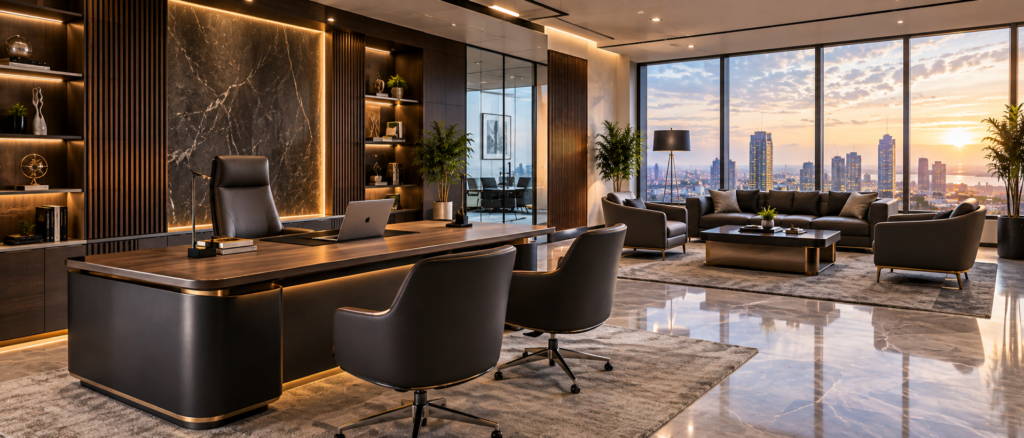
Corporate offices have changed considerably over the last several years. A workplace is no longer expected to be a collection of private offices, desks, and a conference room. Companies increasingly need environments that support focused work, collaboration, technology, employee wellbeing, and a recognizable company identity.
Furniture sits at the center of many of these decisions. The right pieces can influence how employees interact with one another, how visitors experience the company, and how efficiently the available floor area is used.
Corporate Furniture Is Part of Workplace Strategy
Furniture should not be selected only because it looks attractive. A boardroom table, workstation, reception desk, or lounge chair has a job to perform.
For example:
A conference table needs enough surface area for equipment and documents while leaving comfortable space for people to sit. A workstation should provide appropriate working dimensions while allowing cables and technology to be managed neatly.
The best furniture decisions begin with questions about how the company operates.
Consider:
- How many employees work on site?
- Which teams collaborate most often?
- Which activities require privacy?
- How frequently are meetings held?
- Which areas receive visitors?
- What technology is used daily?
- How might the workforce change?
These questions turn furniture selection into a business decision rather than a decorating exercise.
Design Around Different Work Modes
One of the biggest changes in corporate workplace planning is the recognition that employees perform different types of work throughout the day. A person might spend one hour answering emails, another hour in a meeting, and another period working with colleagues. Requiring every activity to happen at the same desk can make the workplace unnecessarily rigid.
A better strategy can involve different settings for different tasks. These might include:
- Individual workstations
- Small meeting rooms
- Informal collaboration areas
- Quiet rooms
- Shared project spaces
- Break areas
- Touchdown workstations
The office becomes more useful when employees have reasonable choices.
Choosing Furniture That Supports Identity
Corporate design should communicate something about the organization without becoming overly decorative. Furniture, finishes, materials, colors, and spatial arrangements can all contribute to the identity of a workplace.
KV Workspace notes that branding can be incorporated through elements such as company colors, mission statements, and visual details. Its corporate projects have used brand colors and modern furniture lines to create offices that reflect individual organizations.
This approach is particularly useful for businesses that receive clients or partners regularly. A well considered workplace can create a consistent visual experience from reception through meeting rooms.
Where corporate design furniture Fits In
The idea of corporate design furniture is most effective when furniture is selected as part of the overall space design rather than purchased item by item. KV Workspace’s corporate office furniture and space design approach combines functionality, aesthetics, technology integration, and workplace needs.
That means a company can consider the relationship between desks, seating, storage, meeting spaces, technology, and branding at the same time. The result is a workplace where individual furniture pieces support a common purpose instead of competing with one another.
Create a Strong Reception Experience
Reception is often the first physical interaction a visitor has with an organization. It should therefore balance appearance with practical requirements. The reception desk needs enough workspace for staff, appropriate storage, technology access, and comfortable interaction with visitors. Seating should be easy to understand and should not interfere with the main circulation route.
The area should also communicate the company’s character. A law firm may choose a more formal environment, while a technology company might use a more relaxed arrangement. There is no universal corporate aesthetic. The important factor is consistency between the environment and the organization.
Build Better Meeting Areas
Meetings require more than a table and several chairs. The room should support the type of conversation that normally occurs there. A boardroom may require a large central table, presentation technology, integrated power, and acoustic privacy. A small team meeting may work better with a compact table and mobile seating.
Furniture should also leave enough room for people to enter and leave comfortably. Technology should be accessible without creating cable clutter. KV Workspace has highlighted integrated power in conference furniture as one way to support modern meetings.
Balance Open Areas With Privacy
Open workplaces can encourage communication, but they can also introduce distractions. Phone calls, conversations, movement, and equipment noise can affect concentration. The solution does not necessarily require returning to rows of private offices. Instead, companies can create a combination of open and enclosed settings. A workplace might include open workstations alongside small enclosed rooms, acoustic elements, and informal spaces.
Quiet Work Requires Intentional Design
Employees who perform detailed or confidential work may need environments where interruptions are limited. Quiet rooms and enclosed workspaces can provide this alternative.
The important point is to make private space easy to access. If employees must reserve a room days in advance just to concentrate for an hour, the design may not be meeting everyday needs.
Collaboration Needs Its Own Environment
Collaboration spaces should also be intentionally designed. A small project team may need a whiteboard, movable furniture, screens, and enough room to rearrange the environment.
Flexible furniture can make these areas useful for multiple activities instead of leaving them empty between scheduled meetings.
Use Technology Without Letting It Dominate
Corporate workplaces now rely heavily on digital tools. Furniture should accommodate those tools without allowing cables, chargers, and screens to dominate the visual environment.
Integrated power, monitor arms, cable management, and technology friendly meeting tables can help create cleaner workstations.
At the same time, technology should remain serviceable. A perfectly concealed cable is not useful if technicians cannot access it when something needs repair.
Consider Employee Wellbeing
Workplace furniture can also support comfort and physical wellbeing. Adjustable desks, supportive seating, appropriate monitor positioning, and varied working positions can give employees more control.
KV Workspace identifies height adjustable desks and monitor arms as examples of ergonomic adjustments that can support workplace wellbeing.
Small adjustments can make a noticeable difference when multiplied across an entire workforce.
Select Materials for Real World Use
Corporate furniture should be selected according to the demands of the environment. A beautiful material that is difficult to clean or maintain may not be appropriate for a busy office.
Consider:
- Frequency of use
- Cleaning requirements
- Expected lifespan
- Replacement availability
- Warranty support
- Resistance to wear
- Ease of maintenance
Durability should be considered alongside aesthetics rather than after them.
Plan for Business Growth
Furniture purchases can represent a significant investment, so companies should think beyond today’s headcount.
Modular systems can make it easier to add or remove workstations. Mobile tables can support changing team sizes. Flexible meeting spaces can be adapted for different purposes.
This approach reduces the likelihood that a company will need to replace an entire furniture system whenever its workforce changes.
Conclusion
Corporate furniture works best when it is treated as part of a larger workplace system. Desks, seating, storage, meeting tables, technology, privacy solutions, and branding should support the way employees and visitors actually use the building. The strongest corporate environments are not necessarily the most elaborate.
They are the ones where every major furniture decision has a clear purpose.By combining practical planning with thoughtful design, businesses can create workplaces that look professional while remaining comfortable, flexible, and ready for changing needs.