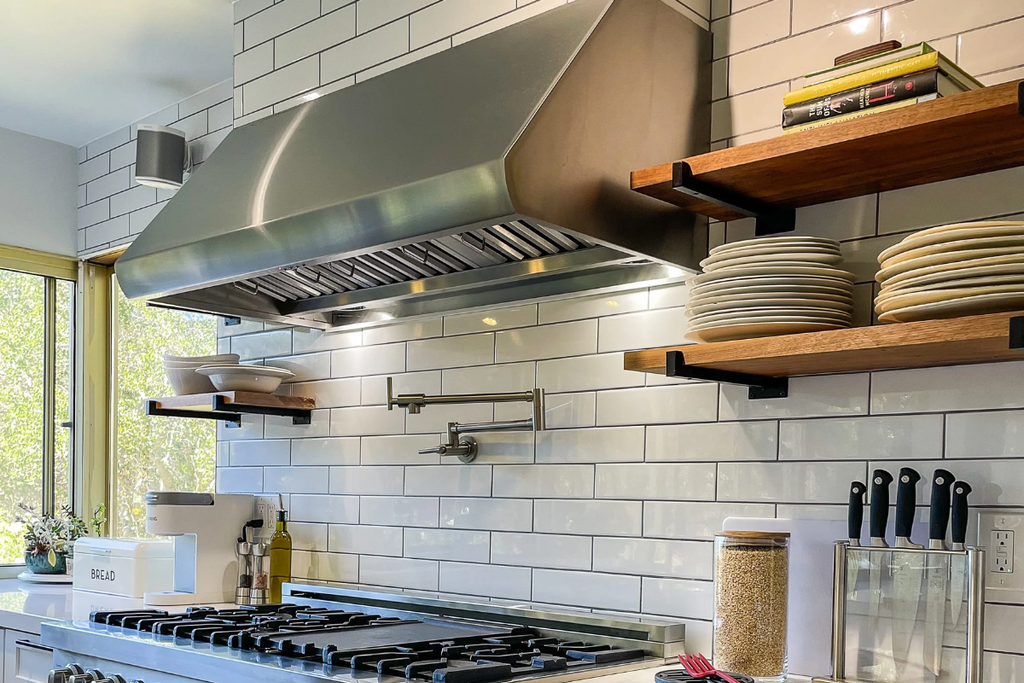
Large cooking surfaces require ventilation equipment that provides sufficient coverage without becoming disconnected from the kitchen’s overall design. A properly sized hood can complement a wide range while providing the airflow needed for the cooking setup. A 60 in vent hood is particularly suited to large residential cooktops, professional-style ranges, and expansive kitchen layouts. However, width is only one part of the selection process. Configuration, CFM, ducting, filtration, materials, and installation requirements should also be considered when comparing options.
Why Consider a 60-Inch Range Hood?
A 60 in vent hood provides substantial coverage for wide cooking surfaces. It can be used with large residential ranges and cooktops, including configurations with multiple burners.
The current Proline 60-inch collection includes wall-mounted, island, under-cabinet, and insert designs. Available models also span different airflow levels, with examples ranging from around 900 CFM to 2,000 CFM depending on the configuration and model.
The larger format can therefore accommodate kitchens where a smaller hood would not provide the same visual or functional coverage.
Match the Hood Width to the Cooking Surface
Hood width should be considered alongside the dimensions of the range or cooktop. 60 in vent hood guide recommends that the hood be at least as wide as the cooking surface and preferably extend beyond its sides for improved capture.
This makes measurement an important first step. A 60-inch hood may be appropriate for a large cooking surface, but the actual range dimensions, installation space, and surrounding cabinetry should all be checked before selecting a model.
Select a Configuration That Fits the Kitchen
The kitchen layout determines which hood configuration makes the most sense. Wall-mounted models work against a wall, island hoods are designed for cooking surfaces positioned in an island, under-cabinet models fit beneath cabinetry, and inserts can be incorporated into custom cabinetry or a hood surround.
Proline’s current 60 in vent hood includes all four configurations, giving homeowners several ways to match ventilation equipment with their kitchen’s physical arrangement.
The configuration should be selected alongside the planned duct route and available installation space.
Understand CFM Requirements
CFM, or cubic feet per minute, measures the volume of air a hood can move. Higher CFM ratings generally indicate greater airflow capacity, but the appropriate level depends on cooking habits, appliance output, kitchen requirements, and the ventilation system.
Proline’s guide provides general ranges of 400–600 CFM for lighter cooking, 600–900 CFM for standard cooking, and 1,000+ CFM for heavy or professional cooking. Its 60-inch collection includes models rated at 1,000, 1,100, 1,200, 1,700, 1,800, and 2,000 CFM, among other configurations.
A higher rating should not automatically be treated as the best choice. The hood, ductwork, and cooking equipment should be considered as one system.
Compare Ducted and Ductless Options
Ventilation systems generally fall into two categories: ducted and ductless. Ducted hoods move air through ductwork and discharge it outside, while ductless models recirculate filtered air back into the kitchen.
Proline’s guide identifies ducted ventilation as the more effective approach for removing cooking byproducts from the living space, while ductless systems use activated charcoal filters for recirculation.
Some 60-inch models in the current collection are ducted, while certain models are convertible to ductless operation.
The home’s existing structure and ability to accommodate exterior ducting should therefore be considered before purchasing.
Pay Attention to Filtration
Filtration is another important part of range hood performance. Baffle filters are commonly used in high-capacity kitchen hoods because their design helps capture grease while allowing the filters to be removed for cleaning.
Proline’s kitchen ventilation guide specifically identifies stainless-steel baffle filters as an option that provides grease capture and can be cleaned in a dishwasher.
When comparing large hoods, homeowners should check the filter design, accessibility, and cleaning requirements instead of focusing solely on the blower rating.
Consider Materials and Finish
The hood’s construction affects both its appearance and suitability for its environment. Stainless steel is widely used for kitchen ventilation equipment because it can complement appliances and contemporary kitchen finishes.
Proline’s 60-inch collection includes 430 stainless steel models as well as premium 304 stainless steel options. Some 304 stainless steel models are specifically listed with outdoor-rated construction.
For indoor kitchens, the surrounding cabinetry and appliances can guide the finish choice. Outdoor installations require additional attention to the material’s suitability for environmental exposure.
Design Should Work With the Kitchen
A large hood naturally becomes a noticeable architectural element, particularly in an open kitchen. Its shape, proportions, and placement can influence the overall appearance of the cooking area.
Proline’s kitchen vent hood guide discusses design elements such as curved forms and geometric lines, showing how a hood can contribute to the visual character of the room rather than functioning solely as equipment.
For a 60-inch installation, maintaining proportion is particularly important. The hood should complement the cooking surface and surrounding cabinetry without making the area feel visually crowded.
Think About Installation Before Buying
A large hood requires adequate space and an appropriate ventilation plan. Duct diameter, route, electrical requirements, mounting structure, and clearance should all be reviewed against the manufacturer’s installation instructions.
The selected configuration can also influence installation. For example, an island hood may require overhead ducting, while a wall-mounted model may allow a more direct route through an exterior wall.
Planning these requirements before purchasing can help prevent compatibility problems during installation.
Conclusion
A 60-inch range hood can provide substantial coverage for large cooking surfaces, but selecting the right model involves more than measuring its width. CFM, configuration, ducting, filtration, construction, and installation requirements all influence the overall performance and suitability of a ventilation system. The visual design matters as well, particularly in kitchens where the hood becomes a prominent architectural feature. For homeowners exploring Kitchen Vent Hoods: The Perfect Blend of Style & Function, evaluating both practical requirements and design considerations can help create a ventilation setup that works cohesively with the entire kitchen.