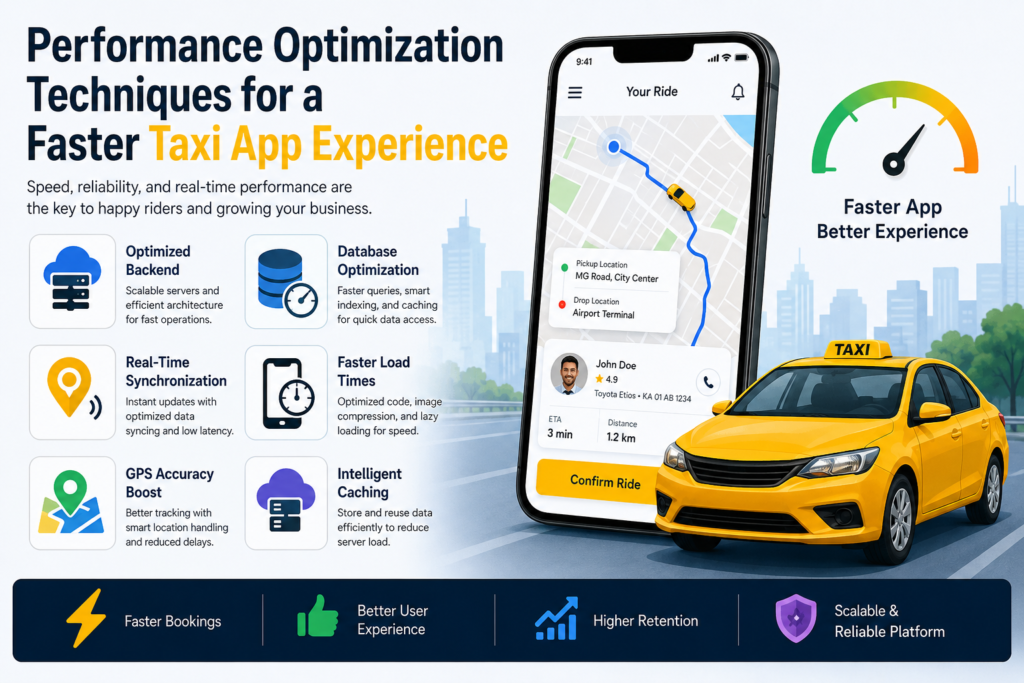
The success of a taxi application depends heavily on its speed, responsiveness, and overall user experience. Modern users expect instant ride confirmations, real-time driver tracking, seamless payments, and uninterrupted communication. Even a few seconds of delay can lead to user frustration and reduced engagement. As competition continues to grow in the ride-hailing industry, businesses must prioritize performance optimization to ensure smooth operations. Whether developing a custom platform or a white label taxi app, focusing on speed and efficiency can significantly improve customer satisfaction and long-term user retention.
Key Statistics Highlighting the Need for Taxi App Performance
The importance of application performance is supported by several industry findings:
- Studies show that users often abandon mobile applications when loading times exceed three seconds.
- Nearly 70% of customers associate app performance with brand reliability and service quality.
- Real-time location tracking remains one of the most frequently used features in ride-hailing applications.
- Mobile users are more likely to continue using apps that provide fast booking confirmations and smooth navigation.
- Performance improvements can positively influence customer retention and ride completion rates.
These statistics emphasize why optimization should be a fundamental part of every taxi application development strategy.
Enhancing Backend Infrastructure for Faster App Operations
The backend serves as the foundation of every taxi application. It manages ride requests, driver matching, route calculations, payment processing, and notifications. A poorly optimized backend can create delays that directly affect the user experience.
Several backend optimization practices include:
- Implementing scalable cloud infrastructure
- Using load balancing to distribute traffic efficiently
- Optimizing database queries
- Reducing server response times
- Utilizing microservices architecture
A scalable backend ensures that the platform can handle thousands of simultaneous ride requests without performance degradation. This becomes particularly important during peak travel hours when demand increases significantly.
For businesses launching a white label taxi app, investing in a robust backend architecture from the beginning helps maintain consistent performance as the user base grows.
Optimizing Database Queries for Faster Ride Processing Times
Databases continuously store and retrieve critical information such as user profiles, ride histories, driver locations, and payment records. Inefficient database operations can slow down the entire application.
Important database optimization techniques include:
- Creating appropriate indexing structures
- Reducing redundant database calls
- Using database caching mechanisms
- Implementing query optimization strategies
- Archiving outdated records periodically
Efficient data retrieval enables faster ride matching and quicker transaction processing. Database performance directly impacts how quickly users can book rides and receive updates.
Additionally, separating frequently accessed data from less critical information can reduce processing loads and improve overall application responsiveness.
Implementing Real-Time Data Synchronization Without Delays
Real-time functionality is one of the defining features of modern taxi applications. Users expect to see driver movements, estimated arrival times, and ride status updates instantly.
However, constant data synchronization can place significant strain on application resources if not managed properly.
Effective optimization approaches include:
- Utilizing WebSocket connections instead of repeated polling
- Compressing transmitted data packets
- Limiting unnecessary location updates
- Implementing intelligent synchronization intervals
- Using event-driven architectures
By reducing communication overhead, developers can deliver real-time updates while maintaining low latency. This creates a smoother experience for both drivers and passengers.
Applications designed with optimized synchronization systems often demonstrate better stability under heavy usage conditions.
Reducing Mobile App Load Time Through Smart Optimization
First impressions matter significantly in mobile applications. Users often decide whether to continue using an app based on how quickly it launches and responds to interactions.
Several techniques can improve application loading speed:
- Compressing images and multimedia files
- Removing unused code libraries
- Minimizing API requests during startup
- Implementing lazy loading techniques
- Optimizing application package sizes
Lazy loading allows the app to load only essential components initially while retrieving secondary resources when needed. This reduces startup delays and improves perceived performance.
Many organizations working with a taxi booking app development company prioritize load-time optimization because it directly affects user engagement metrics and app store ratings.
Regular performance audits can identify bottlenecks before they become major usability issues.
Strengthening GPS Tracking Accuracy and Response Performance
GPS functionality plays a critical role in ride-hailing applications. Accurate location tracking supports efficient driver matching, route navigation, and estimated arrival calculations.
Poor GPS performance can result in:
- Incorrect driver locations
- Delayed ride assignments
- Inaccurate fare estimates
- Customer dissatisfaction
- Reduced operational efficiency
Optimization strategies include:
- Using hybrid positioning methods
- Applying location filtering algorithms
- Reducing unnecessary GPS refresh rates
- Leveraging assisted GPS technologies
- Implementing predictive route calculations
Modern mapping technologies can intelligently balance accuracy and battery consumption, ensuring reliable performance without draining device resources.
For a white label taxi app, dependable location services are essential for maintaining service consistency across different geographic regions.
Leveraging Intelligent Caching to Improve User Experience
Caching is one of the most effective methods for improving application performance. It minimizes repeated requests to servers and databases by temporarily storing frequently accessed information.
Common caching opportunities include:
- User profile data
- Route information
- Driver availability details
- Pricing configurations
- Frequently used maps
Benefits of intelligent caching include:
- Faster screen loading
- Reduced server workload
- Improved application responsiveness
- Lower network usage
- Enhanced scalability
Developers should carefully determine cache expiration policies to ensure users always receive accurate and up-to-date information.
Proper caching implementation creates noticeable improvements in overall application speed while reducing infrastructure costs.
Optimizing API Communication for Faster Feature Execution
Application Programming Interfaces serve as communication channels between mobile applications and backend systems. Slow or inefficient API interactions can significantly impact performance.
Important API optimization techniques include:
- Reducing payload sizes
- Implementing response compression
- Combining multiple requests into single endpoints
- Using asynchronous processing
- Monitoring API latency continuously
Well-designed APIs reduce unnecessary data transmission and improve response times across the platform.
This becomes especially important when evaluating the cost to build taxi app solutions, as efficient architecture can lower infrastructure expenses while maintaining high performance standards.
Continuous API monitoring helps identify performance issues before they affect large numbers of users.
Continuous Monitoring and Testing for Long-Term Performance
Performance optimization is not a one-time activity. User behavior, technology updates, and increasing traffic patterns continuously introduce new challenges.
Organizations should establish ongoing monitoring programs that include:
- Application performance monitoring tools
- Real-time error tracking
- Load testing exercises
- Stress testing simulations
- User experience analytics
Key performance indicators to track include:
- Average response time
- Server utilization
- Crash rates
- API latency
- Ride booking completion times
Companies involved in uber like taxi app development often rely on continuous monitoring to maintain service quality and quickly address emerging performance issues.
Regular testing helps development teams proactively identify weaknesses and implement improvements before they impact end users.
Building Scalable Architectures for Sustainable Growth Ahead
As taxi platforms expand, performance demands increase significantly. Systems that perform well with a few thousand users may struggle when supporting hundreds of thousands of active customers.
Scalability-focused optimization techniques include:
- Containerized deployment environments
- Auto-scaling cloud resources
- Distributed databases
- Content delivery networks
- Fault-tolerant system architectures
Scalable systems ensure consistent performance regardless of user volume or geographic expansion. These strategies allow businesses to accommodate growth without compromising application speed or reliability.
Organizations developing a white label taxi app should prioritize scalability planning early in the development process to avoid costly infrastructure redesigns later.
Conclusion
Performance optimization is a critical factor in delivering a seamless and reliable taxi app experience. From backend infrastructure and database efficiency to GPS accuracy, caching strategies, and API performance, every component contributes to overall application responsiveness. Continuous monitoring, proactive testing, and scalable architecture planning help ensure consistent service quality as user demand grows. By implementing these optimization techniques, businesses can create faster, more dependable applications that meet modern customer expectations and support long-term operational success.
