When researching peptides, you may come across terms like HPLC, purity testing, chromatograms, and COA. These terms can sound technical, especially if you are new to peptide research. However, the basic idea behind them is not too difficult to understand.
HPLC is a laboratory testing method that can be used to check the purity of a peptide sample. For Tesamorelin, HPLC can help show how much of the tested sample is linked to the main compound and whether other substances are also detected.
A Tesamorelin Coa may include HPLC results along with other details about the tested batch. This can include the batch number, test date, product name, testing method, and identity test results.
Understanding how these parts work together can make a laboratory report much easier to read.
What Is Tesamorelin?
Tesamorelin is a synthetic peptide related to growth hormone-releasing hormone, also known as GHRH.
It has been studied in scientific and medical research. When looking at a Tesamorelin research product, it is useful to review more than just the name on the label.
Testing can provide information about the material in a specific sample. Different laboratory methods can be used to look at different parts of the sample.
HPLC is mainly useful for looking at purity, while another method may be used to help check the identity of the compound.
This difference is important because no single test answers every question about a peptide.
What Does HPLC Stand For?
HPLC stands for High-Performance Liquid Chromatography.
It is a laboratory method used to separate substances in a sample. After the substances are separated, the laboratory can measure the signals produced by them.
For peptide testing, HPLC can help separate the main peptide from other substances that may be present in the sample.
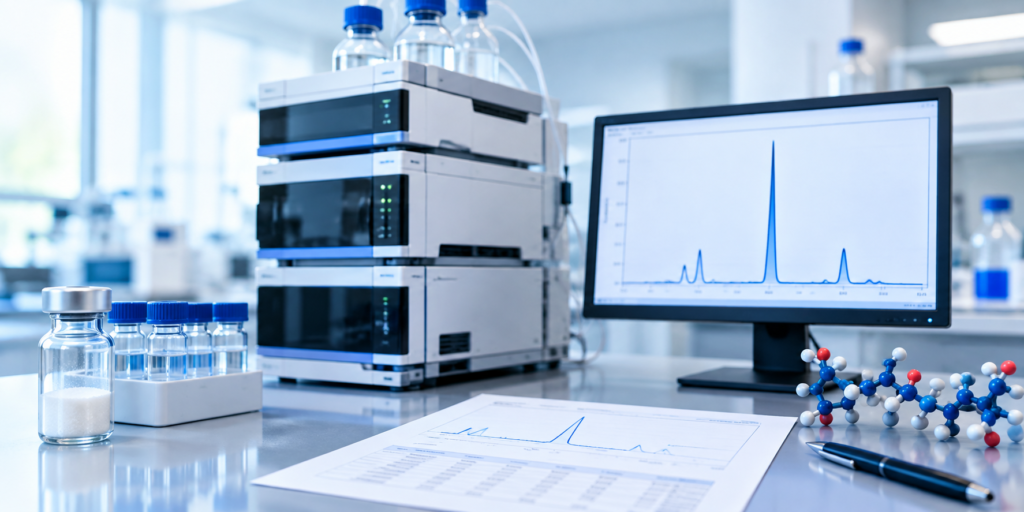
The results are usually displayed as a graph called a chromatogram.
A chromatogram contains peaks. These peaks represent substances detected during the test. The size and position of the peaks can provide useful information about the sample.
Why Is HPLC Used for Tesamorelin?
HPLC can be used to check the purity of a Tesamorelin sample.
During the test, the sample passes through the HPLC system. Different substances move through the system at different rates. This allows them to be separated and measured.
The laboratory can then examine the main peak and other peaks found in the sample.
The reported purity percentage is generally based on the measured areas of the detected peaks under the specific test conditions.
For this reason, an HPLC result can be useful when reviewing the quality information for a particular Tesamorelin batch.
However, an HPLC result should not be treated as the only piece of information needed to understand a product.
What Does HPLC Purity Mean?
HPLC purity is normally shown as a percentage.
In simple terms, this percentage represents how much of the measured chromatographic signal is linked to the expected compound during the test.
For example, if an HPLC report shows a purity result of 99%, the laboratory has found that about 99% of the measured chromatographic area is linked to the target compound under that testing method.
The remaining percentage may be linked to other detected peaks.
It is important to remember that an HPLC purity result does not automatically tell you everything about a sample. It does not replace other tests that may be needed to check identity or other quality factors.
What Is a Chromatogram?
A chromatogram is the graph produced by an HPLC test.
It normally shows the detector response as different substances move through the HPLC system.
The graph may have one large peak and several smaller peaks.
The large peak is often linked to the main compound being tested. Smaller peaks can represent other substances detected during the test.
The laboratory can measure the area of these peaks. The area of the main peak can then be compared with the total measured area to calculate the reported purity.
For beginners, you do not need to understand every part of a chromatogram. The main point is that the graph shows what the HPLC system detected in the sample.
What Is Retention Time?
Retention time is another term that may appear on an HPLC report.
It refers to how long it takes for a particular substance to travel through the HPLC system and reach the detector.
Different substances can have different retention times.
When a laboratory uses an established testing method, the expected retention time of the target compound can help with the analysis.
However, retention time alone should not be treated as complete proof that a sample is Tesamorelin. Other testing methods may be used to provide more information about the identity of the compound.
Does HPLC Confirm the Identity of Tesamorelin?
HPLC purity and identity testing are not exactly the same thing.
HPLC can provide useful information about the purity of a sample, but another test may be used to confirm what the compound actually is.
Mass spectrometry, for example, can be used to examine the mass of a compound and provide information that helps confirm its identity.
This means a COA that includes both HPLC purity and identity testing can provide more information than a report showing only one test.
For beginners, the easiest way to remember this is:
HPLC can help answer, “How pure does the sample appear under this test?”
Identity testing helps answer, “Is this actually the compound it is claimed to be?”
These are two different questions.
What Is a Tesamorelin COA?
COA stands for Certificate of Analysis.
A Tesamorelin Coa is a laboratory document that provides testing information about a particular Tesamorelin sample or batch.
The exact information can vary depending on the laboratory and the tests performed.
A COA may include:
- Product name
- Batch or lot number
- Test date
- Testing laboratory
- HPLC purity result
- Testing method
- Identity test
- Appearance
- Other available test results
A COA is useful because it brings several pieces of testing information into one report.
However, it is important to check whether the report is linked to the specific batch being reviewed.
Why Is the Batch Number Important?
The batch number helps identify a particular production batch.
If a product label shows a batch number, you can compare that number with the one shown on the COA.
Ideally, the COA should clearly relate to the same batch.
This matters because testing results from one batch do not automatically describe another batch. A report from an older batch should not simply be used as proof of the results for a newer batch.
Checking the batch number is therefore one of the first things you should do when reviewing a COA.
How to Read HPLC Results on a Tesamorelin COA
A laboratory report may look complicated, but you can start by checking a few simple details.
1. Check the Product Name
First, make sure the report clearly identifies the material as Tesamorelin.
2. Find the Batch Number
Look for the batch or lot number. Compare it with the product information.
3. Check the Test Date
The test date tells you when the sample was tested.
4. Find the HPLC Purity Result
Look for wording such as “HPLC Purity” or “Purity by HPLC.”
The result is usually given as a percentage.
5. Look at the Testing Method
The report may provide details about the HPLC method used by the laboratory.
6. Check for Identity Testing
If the COA includes mass spectrometry or another identity test, review that information separately from the HPLC purity result.
These steps can help make a technical report easier to understand.
Why Can HPLC Results Be Different?
HPLC results do not have to be exactly the same for every sample or batch.
Different batches can have different test results. Laboratories may also use different equipment, methods, and reporting systems.
For this reason, you should focus on the actual test report for the batch you are reviewing instead of expecting every report to show the same number.
A small difference in a reported result does not automatically mean that something is wrong. The full testing information should be considered.
What Other Tests May Be Included?
HPLC may be only one part of a larger testing report.
Depending on the product and laboratory, a COA may also include identity testing, peptide content, appearance, or other laboratory checks.
Each test has a different purpose.
For example, HPLC can provide information about purity, while mass spectrometry can help with identity.
This is why it is better to look at the full COA instead of focusing only on the HPLC percentage.
Common Mistakes When Reading HPLC Reports
Looking Only at the Purity Percentage
A high purity number can be useful, but it does not provide all the information about a sample.
Ignoring the Batch Number
Always check that the COA relates to the batch being reviewed.
Confusing Purity With Identity
Purity testing and identity testing are different. One does not automatically replace the other.
Assuming Every HPLC Test Is the Same
Testing methods and report formats can vary between laboratories. Read the information provided on the specific report.
Treating a COA as a Safety Guarantee
A COA only reports the results of the tests that were performed. It does not automatically prove that a product is safe for every purpose or approved for human use.
Is HPLC Enough to Check Tesamorelin?
HPLC can provide useful information about the purity of Tesamorelin, but it is not the only type of testing that may be useful.
A more complete review can include the HPLC result, identity testing, batch information, test date, and other available laboratory results.
The tests needed can depend on the material and the purpose of the analysis.
For someone new to peptide research, the main point is simple: HPLC is an important testing method, but one number should not be used to judge every part of a product.
What Should Beginners Check First?
If you are looking at a Tesamorelin COA for the first time, start with the basic information.
Check the product name and batch number. Then look at the test date and laboratory information.
Find the HPLC purity result and read how the test was performed if that information is provided.
After that, check whether the report includes an identity test or other laboratory results.
Taking these steps can help you understand what the report actually shows instead of focusing only on a single percentage.
Final Thoughts
HPLC testing is a useful laboratory method for checking the purity of Tesamorelin. It separates substances in a sample and produces a chromatogram that can be examined by the laboratory.
A Tesamorelin Coa may provide the HPLC purity result along with the batch number, test date, testing method, and other test information.
When reviewing a COA, do not look at the purity percentage alone. Check that the batch number matches, understand what the HPLC result means, and look for separate identity testing when available.
For more information about research peptide products and product details, you can visit Gold Label Peptides.
