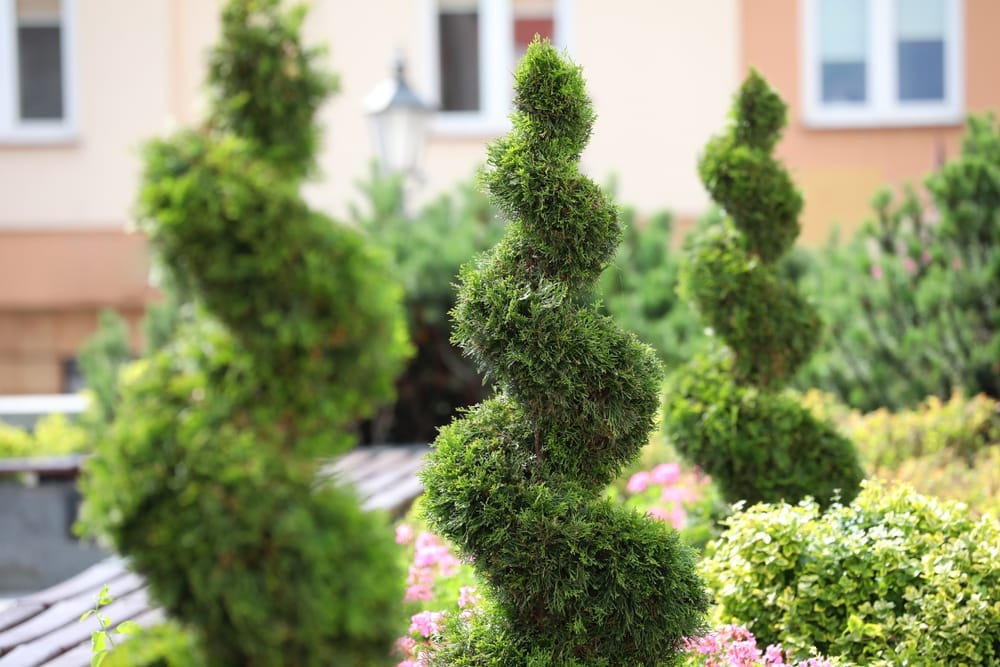
Tall, narrow evergreen trees can add structure, screening, and year-round greenery to many landscape designs. Among the options available for warm and relatively dry climates, Italian Cypress is notable for its distinctly columnar form and formal appearance. Botanically known as Cupressus sempervirens, this conifer is native to southern Europe and western Asia and is naturally associated with warm, fairly dry environments.
Its upright growth makes it useful where a landscape needs vertical interest without the broad footprint of a conventional shade tree. Before planting Italian Cypress, however, homeowners should consider climate, sunlight, drainage, mature size, watering needs, and the purpose of the planting.
What is Italian Cypress?
Italian Cypress is an evergreen conifer in the cypress family, Cupressaceae. It is recognized by its narrow, columnar canopy, scale-like foliage, and red-brown bark. Depending on the cultivar and growing conditions, its foliage can range from green to dark green, while some cultivars offer blue-green or yellow-green coloration.
The tree is generally considered a medium-growth-rate species and has high potential mature height and longevity. Utah State University Extension lists it for USDA hardiness zones 7 through 9 and notes that it has high drought tolerance but low tolerance for poor drainage.
These characteristics make site selection an important part of successful planting.
Why is Italian Cypress Used in Landscaping?
The strongest visual characteristic of Italian Cypress is its vertical form. Instead of spreading broadly across a yard, the tree grows upward in a relatively narrow shape. This allows it to create height and visual structure without occupying as much horizontal space as many other trees.
Landscape designers can use columnar evergreens to frame entrances, define property boundaries, emphasize architectural features, or create repeated vertical elements along pathways.
Plants can also serve functional purposes beyond decoration. Extension guidance on water-wise landscaping notes that vegetation can be used to screen unwanted views, provide privacy, reduce wind or noise, and define outdoor spaces.
Can Italian Cypress Provide Privacy?
Yes, its narrow evergreen structure can make it useful for screening when planted appropriately. A single tree creates a vertical visual element, while a carefully planned group can form a continuous screen as the trees mature.
However, homeowners should avoid assuming that every planting arrangement will immediately provide complete privacy. Young trees need time to establish and develop their mature form. Spacing also matters because trees planted too far apart may leave gaps, while planting them excessively close together can create unnecessary competition for water, nutrients, and growing space.
The intended screening height, available planting area, mature dimensions, and local climate should all be considered before deciding on spacing.
How Much Sun Does Italian Cypress Need?
Italian Cypress performs best in sunny locations. Utah State University Extension describes the species as shade intolerant, meaning heavily shaded planting sites are generally unsuitable.
A location with sufficient sunlight can support healthy foliage and the characteristic upright form for which the species is known. Before planting, observe the site at different times of day and consider whether nearby buildings, walls, large trees, or other structures will create significant shade.
Sun exposure can also affect irrigation needs because sunny areas generally lose moisture more rapidly than shaded areas.
What Soil Conditions Does Italian Cypress Prefer?
Drainage is particularly important. Although the tree has high drought tolerance, it has low tolerance for poor drainage, according to Utah State University Extension.
This distinction is important because drought tolerance does not mean a plant should be kept completely dry or placed in waterlogged soil. Roots require adequate oxygen, and prolonged saturation can create unfavorable conditions.
Before planting, assess whether water drains away from the planting area after rainfall or irrigation. Compacted soil or locations where water remains for extended periods may require improvement or a different planting strategy.
How Should Italian Cypress Be Watered?
Watering requirements change as a tree becomes established. Newly planted trees generally need more careful monitoring because their root systems have not yet expanded into the surrounding soil.
The Missouri Botanical Garden recommends paying particular attention to watering during the first two to three years after planting and cautions against keeping soil saturated for long periods.
Once established, Italian Cypress is relatively drought tolerant. However, drought tolerance should not be interpreted as a reason to ignore prolonged periods of heat and low rainfall. Newly planted trees are especially vulnerable because they have not developed extensive root systems.
Deep, appropriate watering can encourage roots to access moisture farther into the soil. During drought, extension guidance recommends watering deeply and less frequently rather than applying small amounts of water repeatedly.
Does Italian Cypress Require Regular Pruning?
The naturally narrow shape is one reason the tree is popular in formal landscapes, so extensive pruning may not always be necessary. Maintenance should focus on removing dead, damaged, or problematic growth and preserving the desired form.
Pruning decisions should account for the particular cultivar and the tree’s growth pattern. It is also important to consider mature height before planting rather than depending on frequent pruning to keep a naturally tall tree permanently small.
USU Extension classifies the species as having high mature-height potential and notes that it is not suitable beneath power lines.
How Can Italian Cypress Fit Into a Water-Wise Landscape?
A water-wise landscape is not simply a landscape where plants receive little water. It involves selecting plants suited to the site, using efficient irrigation, improving soil conditions, and matching watering practices to plant requirements.
Italian Cypress can fit into suitable water-wise landscapes because of its high drought tolerance. Still, newly planted specimens require adequate establishment watering, and poor drainage should be avoided.
Mulching can also help reduce evaporation and moderate soil conditions. Water-wise landscaping guidance recommends appropriate mulch while keeping it away from direct contact with woody plant stems.
What Should You Consider Before Planting?
Before adding Italian Cypress to a landscape, consider several practical questions:
- Is the local climate suitable for the species?
- Does the site receive enough sunlight?
- Does the soil drain adequately?
- Is there enough room for the tree’s mature height?
- Will roots and branches interfere with structures or utilities?
- Is the goal ornamental, screening, framing, or a combination?
- Can newly planted trees receive appropriate irrigation during establishment?
Thinking about these factors before planting can reduce maintenance problems later and help the tree develop in a location suited to its natural characteristics.
Conclusion
Italian Cypress offers a distinctive combination of evergreen foliage, narrow growth, drought tolerance, and formal vertical structure. Its characteristics make it useful for framing, landscape definition, and screening when the planting site provides adequate sunlight and well-drained soil. For homeowners considering privacy trees, careful planning is more important than simply choosing a tall evergreen. Evaluate mature size, spacing, drainage, sunlight, and establishment watering before planting. With the right site and appropriate care, this columnar conifer can contribute year-round structure while fitting effectively into landscapes designed around both appearance and practical space requirements.
