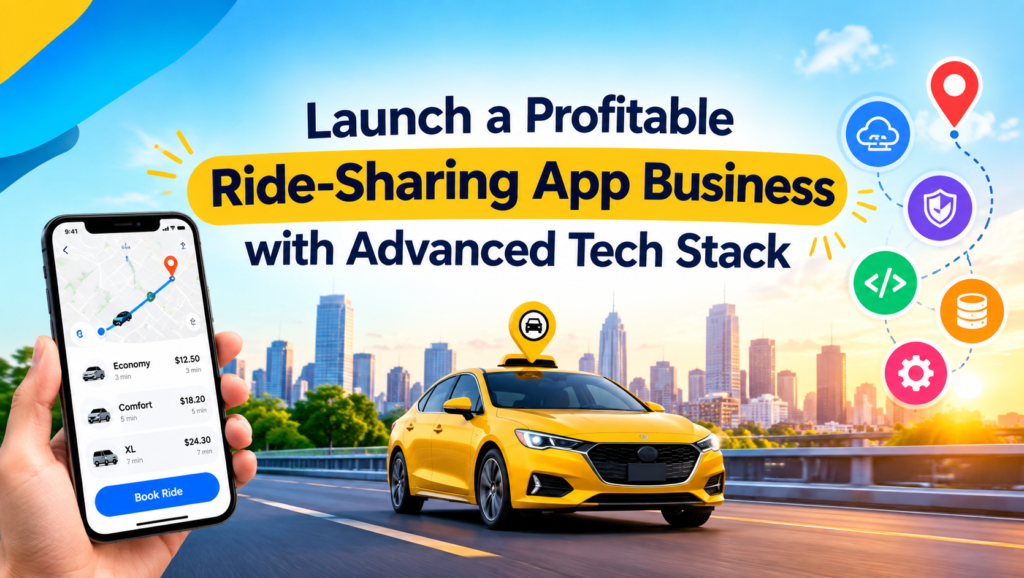
The ride-sharing industry in the USA is far from slowing down. Commuters expect instant bookings, transparent pricing, and real-time tracking, while drivers want fair earnings and efficient trip allocation. For entrepreneurs eyeing this space, the opportunity is massive — but only if the app itself is built on a tech stack strong enough to support scale, security, and speed.
If you’re planning to enter the ride-hailing market, this guide walks you through what it actually takes to launch a profitable ride-sharing app business, the technology that powers successful platforms like Uber and Lyft, and why choosing the right development partner matters more than ever.
Why the Ride-Sharing Market Is Still a Goldmine
Despite being a mature market, ride-sharing continues to grow because of shifting consumer habits — fewer people want to own cars, cities are investing in smart mobility, and EV adoption is reshaping fleet economics. Add to that the rise of corporate travel apps, tourism-focused taxi services, and air taxi concepts, and it’s clear this isn’t a one-size-fits-all industry anymore.
This diversification is exactly why generic apps fail and why businesses are increasingly turning to specialized taxi app development services that can tailor a platform to a specific niche — whether that’s a city-based cab network, a corporate transportation service, or an EV-only ride fleet.
The Core of a Profitable Ride-Sharing App: The Tech Stack
A ride-sharing app isn’t just a booking button and a map. Underneath the simple interface sits a complex system of real-time data processing, geolocation, payments, and dispatch logic. Here’s what a modern, scalable tech stack typically includes:
1. Real-Time GPS & Mapping
Accurate location tracking is non-negotiable. Integrations with Google Maps or Mapbox APIs allow passengers to track drivers live, get accurate ETAs, and receive optimized routes — all of which directly impact customer retention.
2. AI-Powered Dispatch & Matching
Smart dispatch systems use algorithms to match the nearest available driver with a rider in seconds, factoring in traffic, demand zones, and driver ratings. This is where AI/ML genuinely earns its place — not as a buzzword, but as a mechanism that reduces wait times and increases ride completion rates.
3. Dynamic Pricing Engines
Surge pricing, discount logic, and fare estimation all run on backend algorithms that adjust in real time based on demand, weather, and traffic conditions. Getting this right is often the difference between a profitable platform and one that bleeds margin during peak hours.
4. Secure Payment Gateways
Multiple payment options — cards, wallets, and increasingly crypto — need to be integrated with fraud detection layers built in. Riders expect a frictionless checkout, and drivers expect fast, accurate payouts.
5. Cloud Infrastructure
Scalable cloud hosting ensures the app doesn’t crash during demand spikes, whether that’s a Friday night rush or a citywide event. It also supports data backup, analytics processing, and multi-region expansion down the line.
6. IoT & Fleet Monitoring
For businesses running their own fleet, IoT sensors provide real-time vehicle health data, fuel or battery levels, and driver behavior analytics — useful for both safety and operational efficiency.
Together, these components form the backbone of any serious ride-hailing platform, and it’s precisely why experienced taxi app development services providers focus so heavily on backend architecture before touching the UI.
Key Features That Drive Profitability
Beyond the tech stack, certain features consistently separate profitable ride-sharing apps from apps that struggle to retain users:
- Instant Ride Booking — Reduce steps between opening the app and confirming a ride.
- Fare Estimation Upfront — Builds trust and reduces cancellation rates.
- Ride Scheduling — Captures the corporate and airport transfer market.
- In-App Chat & Call — Improves pickup coordination without exposing personal numbers.
- Driver Earnings Dashboard — Increases driver retention, which directly affects supply-side reliability.
- Admin Analytics Panel — Gives founders visibility into revenue, ride volume, and churn — critical for making data-driven business decisions.
None of these features work well in isolation. They need to be built as an integrated system, which is exactly what professional taxi app development services are designed to deliver — a cohesive platform rather than a patchwork of disconnected tools.
Choosing the Right Business Model
Before writing a single line of code, founders need to decide on a model:
- Custom-Built App — Full ownership, complete flexibility, higher upfront investment.
- White-Label Solution — Faster to launch, built on a proven framework, customizable branding.
- Niche-Focused App — Tourism taxis, corporate transport, or EV-only fleets that target underserved segments.
Each path has different cost implications and timelines, so it’s worth having a clear conversation with your development partner about which model fits your budget and go-to-market strategy.
Why the Right Development Partner Matters
A lot of founders underestimate how much the success of a ride-sharing app depends on the technical execution behind it. Poor GPS accuracy, laggy dispatch systems, or unreliable payment processing will kill user trust faster than any marketing campaign can rebuild it.
This is where partnering with an experienced provider of taxi app development services becomes a genuine competitive advantage. The right team doesn’t just write code — they bring insight into what features actually drive retention, how to structure a scalable architecture from day one, and how to avoid the common pitfalls that cause ride-hailing startups to stall after launch.
Look for a partner that can demonstrate:
- A track record of shipping GPS-integrated, multi-platform ride-hailing apps
- Experience with dynamic pricing and AI-based dispatch logic
- Strong post-launch support and iteration capability
- Transparent, milestone-based development process
Final Thoughts
Launching a profitable ride-sharing app business in 2026 isn’t about copying Uber — it’s about identifying a gap in the market and backing it with a tech stack built for real-time performance, security, and scale. Whether you’re targeting a specific city, a corporate client base, or the growing EV mobility segment, the foundation of your success will always trace back to the quality of development behind your app.
If you’re ready to move from idea to execution, working with a team that specializes in taxi app development services can save you months of trial and error — and get your platform in front of riders faster, with fewer costly mistakes along the way.
