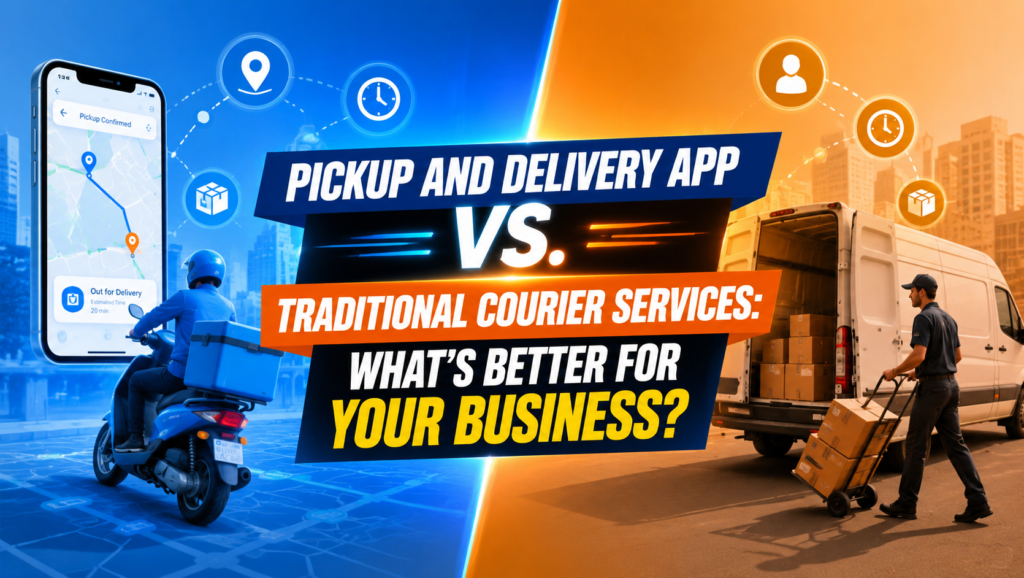
If you’re running a business that depends on getting goods from point A to point B, you’ve probably asked yourself this question at some point: should you stick with a traditional courier service, or is it time to invest in a pickup and delivery app?
It’s not a trivial decision. The logistics model you choose affects your costs, your customer experience, and how easily you can scale. In this article, we’ll break down the real differences between a delivery app vs courier service, so you can figure out which one actually makes sense for your business in 2026.
The Traditional Courier Model: How It Works
Traditional courier services have been around for decades, and for good reason — they work. You call a courier company, they send a driver, the package gets picked up and delivered, and you get an invoice at the end of the month. It’s a manual, relationship-driven process built on phone calls, paper trails, and a fixed network of drivers.
For businesses with predictable, low-volume shipping needs, this model still holds up. A small law firm sending occasional documents across town doesn’t need a full-blown delivery app. A courier service does the job just fine.
But as businesses scale, or as customer expectations shift toward real-time visibility, the cracks in the traditional courier model start to show.
The Pickup and Delivery App Model: How It Works
A pickup and delivery app development services flips the entire process on its head. Instead of calling someone and waiting for a callback, customers (or business owners) open an app, request a pickup, and watch the order move from acceptance to delivery in real time. Behind the scenes, the app handles driver assignment, route optimization, payment processing, and customer notifications — all automatically.
This is the model powering everything from food delivery giants to grocery platforms to niche services like laundry and pharmacy delivery. And increasingly, businesses that once relied entirely on courier companies are asking their app development partners to build them a private-label version of the same experience.
Key Differences That Actually Matter
1. Speed and Real-Time Visibility
This is where the gap is widest. Traditional couriers typically operate on a “trust the process” basis — you hand off the package and hope it arrives on time. There’s rarely a live map, a driver ETA, or a notification the moment your delivery is picked up.
A delivery app changes that completely. GPS-based tracking, live driver locations, and automated status updates aren’t nice extras — they’re now the baseline expectation for any consumer-facing delivery experience. If your customers are used to tracking their food order down to the minute, they’ll expect the same from any business that delivers to them.
2. Cost Structure
Courier services often charge a flat or distance-based rate per delivery, sometimes with added fees for rush requests, waiting time, or after-hours pickups. These costs are relatively easy to predict but tend to get expensive fast at higher volumes.
A pickup and delivery app, once built, shifts the cost structure toward a more scalable model. You’re paying for the technology, driver network, and operational efficiency rather than a per-transaction premium for every single job. At scale, most businesses find that an app-based delivery system costs significantly less per order than relying on third-party couriers — especially once you factor in the added revenue from better customer retention.
3. Scalability
This is probably the biggest differentiator. Traditional courier companies are constrained by how many drivers they can physically dispatch and manage manually. If your order volume doubles overnight, a courier service may struggle to keep up without a proportional increase in staff and coordination effort.
A delivery app, backed by automated dispatch and route optimization algorithms, scales far more gracefully. Whether you’re processing 50 orders a day or 5,000, the underlying system handles the complexity without requiring you to hire an army of dispatchers.
4. Customer Experience and Branding
Here’s something a lot of business owners overlook: when you use a third-party courier, your customer’s entire delivery experience is happening on someone else’s brand. The tracking (if any), the notifications, the driver interaction — none of it reinforces your business.
With a custom pickup and delivery apps, everything from the confirmation email to the in-app tracking screen carries your branding. That consistency builds trust and keeps your business top of mind, rather than fading into the background behind a generic courier logo.
5. Flexibility and Customization
Courier services are largely one-size-fits-all. You get the service they offer, on their terms, with limited room for customization.
A delivery app, on the other hand, can be built around your exact operational needs — flexible pricing zones, scheduled vs. on-demand delivery, multi-vendor support, loyalty programs, and integration with your existing inventory or POS systems. This level of customization simply isn’t available when you’re outsourcing to a generic courier network.
When a Traditional Courier Still Makes Sense
To be fair, traditional couriers aren’t obsolete. They still make sense in specific scenarios:
- Low, unpredictable volume. If you’re shipping a handful of packages a week, building or subscribing to an app may not be worth the investment yet.
- Highly specialized deliveries. Certain freight, oversized items, or regulated goods (medical specimens, for example) often require couriers with specific certifications and equipment.
- No in-house tech resources. If you’re not ready to manage or maintain a digital platform, a courier partnership requires far less operational overhead.
For these cases, sticking with a courier service — at least for now — is a reasonable choice.
When a Pickup and Delivery App Is the Better Investment
On the flip side, an app-based model tends to be the smarter long-term move if:
- You’re delivering directly to consumers and competing with businesses that already offer real-time tracking.
- Your delivery volume is growing and you’re starting to feel the cost and coordination strain of manual courier bookings.
- Brand experience and customer retention matter to your business model.
- You want data. A delivery app gives you visibility into delivery times, customer behavior, driver performance, and operational bottlenecks — insights a courier invoice simply can’t provide.
- You’re planning to expand into new delivery categories (groceries, pharmacy, retail, B2B logistics) where a flexible, scalable platform pays off across multiple verticals.
The Hybrid Approach
It’s worth noting that this isn’t always an either/or decision. Plenty of growing businesses run a hybrid model — using an in-house or white-label delivery app for their core, high-volume routes, while still leaning on traditional couriers for overflow capacity, specialized shipments, or markets where they haven’t built out their own driver network yet.
This approach lets you capture the branding and cost advantages of an app while keeping the flexibility of an established courier relationship as a safety net.
Making the Right Call for Your Business
There’s no universal answer to the delivery app vs courier debate — it depends on your order volume, your customers’ expectations, your budget, and how central delivery is to your overall business strategy. A small business shipping occasional packages may be perfectly served by a courier. But if delivery is core to how you generate revenue — think food, grocery, pharmacy, retail, or logistics — a custom pickup and delivery app is very likely where the market, and your customers, are headed.
The businesses that get ahead in the next few years won’t just be the ones offering delivery — they’ll be the ones offering a delivery experience customers actually trust and return to. That’s something a generic courier invoice was never designed to deliver.