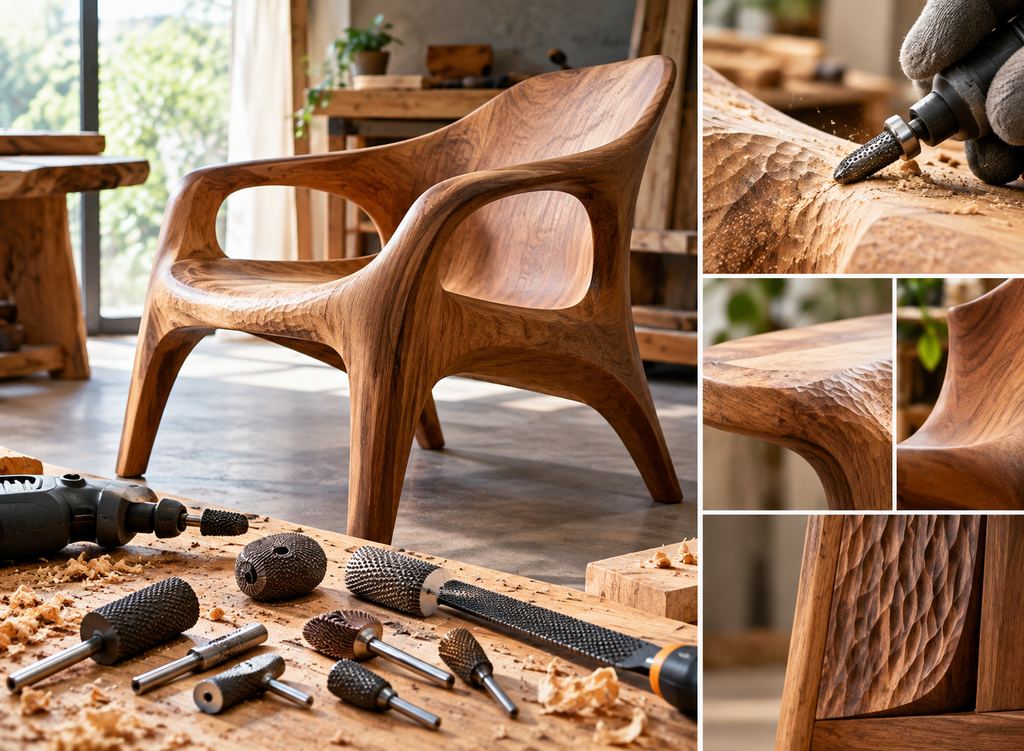
Furniture does not have to be defined by straight lines, sharp corners, and conventional profiles. Sculpted furniture combines traditional woodworking with controlled shaping to create flowing contours, softened transitions, textured surfaces, and ergonomic forms. Power carving is particularly useful during the refinement stage, when a furniture maker moves beyond basic cutting and joinery to shape the piece according to its intended function and appearance.
What Makes Furniture Sculptural?
Power carving does not replace traditional woodworking. Instead, it adds another stage of shaping after boards and components have been cut, milled, and assembled.
Sculpted furniture emphasizes form as much as construction. Instead of leaving every surface flat or mechanically uniform, makers can introduce curves, recesses, rounded edges, and organic transitions.
These details can serve practical purposes as well. A shaped chair seat or armrest can follow the body’s contours, while softened table edges can change how a piece feels when handled. Carving can also blend joints, laminated curves, and other transitions so that separate components appear more visually integrated.
Choosing the Right Wood Sculpting Tools
Shaping wheels are useful when substantial material needs to be removed or broad curves need to be established. Burrs mounted in rotary tools can provide more control for smaller details, textures, and transitions. Hand rasps can then help refine surfaces manually, particularly in areas where precise directional control is important. The result is sculpted furniture that combines traditional craftsmanship with more expressive shaping possibilities.
Kutzall’s furniture-making collection includes shaping wheels, contour wheels, burrs, hand rasps, and burr kits intended for different stages of shaping and refinement.
Matching Tools to the Shape
Tool selection should follow the geometry of the furniture rather than simply choosing the most aggressive cutter available. A broad surface may benefit from a larger shaping wheel, while a concave area or tight transition can require a more specialized profile.
Hand rasps provide another level of control. Flat rasps can help level surfaces and round edges, while half-round profiles are suited to concave areas and rounded transitions. Warding rasps have a narrower profile for tighter spaces and detail work.
The coarseness of the cutting surface also matters for sculpted furniture. Coarser tools can remove material quickly during rough shaping, while finer options are more appropriate as the surface approaches its intended form.
Creating Ergonomic Furniture Forms
One of the practical benefits of sculptural shaping is the ability to modify surfaces according to human interaction. Furniture is touched, supported, leaned against, and used repeatedly, so comfort can be influenced by the geometry of those contact areas.
Chair seats and backs, armrests, handles, and other frequently contacted components can be shaped to create smoother transitions and more natural contours in sculpted furniture. Power carving gives makers direct control over these areas while allowing material to be removed progressively rather than committing to a single fixed profile.
This is particularly useful when working with custom furniture where the dimensions and contours are developed specifically for a particular design.
Adding Texture and Visual Character
Sculpting can also change the visual and tactile quality of a piece without altering its fundamental structure. Makers can introduce grooves, irregular textures, relief details, and flowing surface patterns.
Texture can be concentrated in selected areas rather than applied uniformly. For example, a mostly smooth table can feature a carved edge, while a cabinet panel can combine a flat structural surface with a textured central feature.
Power carving tools are designed for applications ranging from rapid stock removal to detailed surface work, making them useful across multiple stages of furniture development.
Conclusion
Creating distinctive furniture involves more than assembling accurately cut components. Sculpting techniques can introduce curves, ergonomic contours, textures, and transitions that give a piece greater visual and tactile character. With the appropriate wood sculpting tools, furniture makers can move progressively from rough material removal to controlled refinement while maintaining the underlying structure and design of the piece.
