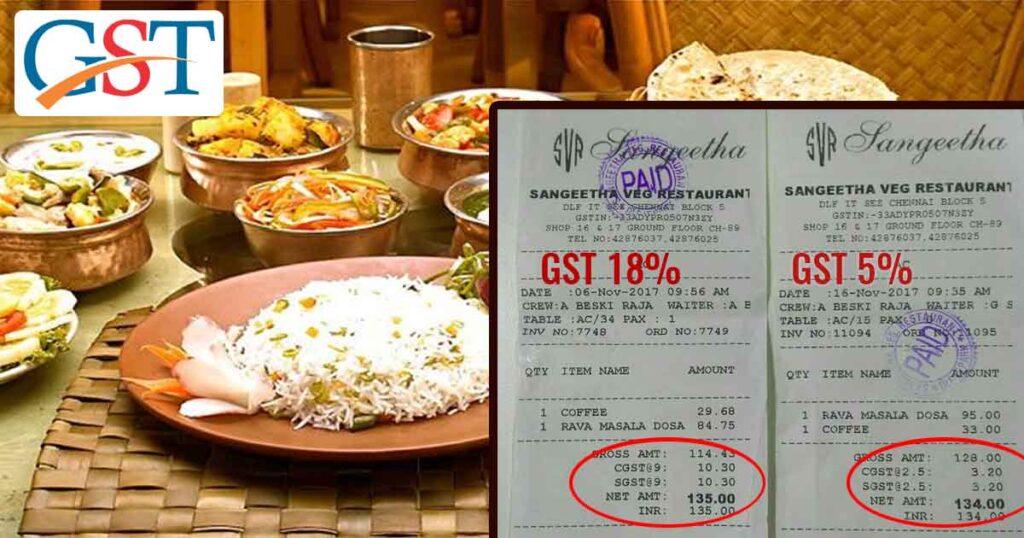
The Goods and Services Tax (GST), introduced in India in July 2017, brought significant changes to the country’s taxation system. Multiple indirect taxes into one unified tax regime, GST simplified compliance and streamlined tax administration. However, the application of GST varies across sectors due to the diverse nature of goods and services provided. Among the industries significantly impacted, restaurants and hotels are two prime examples. Despite their similarities as service-based businesses, the GST structure for restaurants differs significantly from GST on hotels due to the nature of services offered, input tax credit eligibility, and applicable tax rates.
This article explores the nuances between GST on restaurants and GST on hotels, explaining the differences to provide clarity for businesses and consumers alike.
GST on Restaurant
Restaurants are integral to India’s hospitality and service industry, catering to food lovers through dine-in, takeaway, and delivery options. The GST on restaurant services applies to various types of establishments, including standalone outlets, food courts, and eateries within malls or office premises. The GST structure here is influenced by whether the restaurant opts for regular registration or the composition scheme, the presence of in-house service facilities, and whether the establishment is air-conditioned.
GST Rates on Restaurant Services
Under the GST regime, restaurants attract different tax rates depending on their category:
1. 5% GST Without Input Tax Credit (ITC):
– Applicable to regular restaurants, irrespective of whether they are air-conditioned or not.
– Includes GST on food and beverages offered as dine-in, takeaway, or delivery.
2. 18% GST With ITC:
– Applicable to restaurants located within hotels where the declared room tariff exceeds ₹7,500 per night.
– Businesses under this category can benefit from input tax credit (ITC) on their purchases.
Composition Scheme for Restaurants
Small-scale restaurants and eateries with an annual turnover of less than ₹1.5 crore can opt for a composition scheme under GST. Under this scheme, restaurants are taxed at a lower rate of 5% GST, but they forego the benefit of ITC.
This scheme is intended to simplify tax compliance for smaller establishments, allowing them to focus on running their business efficiently without being burdened by complex taxation processes.
Input Tax Credit for Restaurants
Input Tax Credit (ITC) plays a pivotal role in GST compliance, allowing registered businesses to claim credit for GST paid on expenses related to their business operations. However, under the 5% GST rate applicable to standalone restaurants, ITC is not available. Restaurants operating within hotels that charge an 18% GST rate, however, are eligible to claim ITC, helping them reduce their overall GST liability.
GST Compliance for Restaurants
Restaurants must adhere to key compliance requirements under GST rules, including:
1. Mandatory GST Registration:
– Restaurants with a turnover exceeding ₹40 lakh (₹20 lakh for Northeastern and hilly states) must register under GST regulations.
– Businesses can opt for the composition scheme if their turnover is less than ₹1.5 crore.
2. Dining Bills and GST Charges:
– Restaurants are required to clearly mention applicable GST charges on customer bills.
– Careful segregation between GST and service charge (if applicable) ensures transparency.
3. Regular GST Filing:
– Restaurants are obligated to file monthly, quarterly, or annual GST returns depending on their registration type.
– Accurate reporting ensures compliance and prevents penalties from tax authorities.
GST on Hotel
The hotel industry is another key player in India’s hospitality sector. Unlike restaurants, hotels offer a variety of services that go beyond dining. Hotels provide accommodation, catering services, and additional amenities such as spas, conference rooms, and recreational spaces. Due to these diverse services, GST on hotel services is structured differently and is primarily based on the tariff charged per room per night.
GST Rates on Hotel Accommodation
The GST rates for hotel accommodation vary based on the declared room tariff:
1. No GST for Tariff Below ₹1,000 Per Night:
– Hotel rooms with tariffs less than ₹1,000 per night are exempt from GST, making budget accommodations more affordable for travelers.
2. 12% GST for Tariff Between ₹1,001 and ₹7,500 Per Night:
– Mid-range accommodations fall under this category, ensuring reasonable tax burdens for travelers availing such services.
3. 18% GST for Tariff Between ₹7,501 and ₹10,000 Per Night:
– Premium accommodations attract higher GST rates, reflecting the luxury nature of services offered.
4. 28% GST for Tariff Above ₹10,000 Per Night:
– Five-star and luxury hotels fall under this category, attracting the highest GST rate due to their exceptional services and facilities.
Input Tax Credit for Hotels
Unlike standalone restaurants taxed at 5% GST with no ITC, hotels can claim ITC for input expenses such as building maintenance, furnishing, catering, and other operational costs. ITC benefits hotels by allowing them to offset the GST paid on such expenses against their taxable income.
GST Compliance for Hotels
Similar to restaurants, hotels must comply with GST regulations to ensure seamless operations and avoid penalties:
1. Mandatory GST Registration:
– All hotels must register under GST if their annual turnover exceeds the threshold limit of ₹40 lakh (₹20 lakh for Northeastern and hilly states).
2. Invoice Issuance:
– Hotels must provide customers with GST-compliant invoices detailing applicable taxes, helping maintain transparency and accountability.
3. Returns Filing:
– Hotels are obligated to file GST returns based on their registration type and turnover.
4. Separate GST Rates for Packages:
– Composite packages providing room tariffs, dining services, and other amenities may require varied GST rates based on individual components.
Key Differences Between GST on Restaurant and GST on Hotel
While both restaurants and hotels fall under the hospitality sector, their GST structures differ significantly due to the nature of services provided. Here are the key differences between GST on restaurants and GST on hotels:
1. Scope of Services
– Restaurant: Primarily focuses on food and beverages; limited to dining, takeaway, and delivery services.
– Hotel: Offers accommodation, dining, corporate conferencing, recreational facilities, spas, and catering services.
2. Tax Rates
– Restaurant:
– 5% GST (without ITC) for standalone restaurants.
– 18% GST (with ITC) for restaurants in hotels with tariffs exceeding ₹7,500 per night.
– Hotel:
– Ranges from 0% to 28% GST based on room tariff, with no GST on tariffs below ₹1,000 per night.
3. Input Tax Credit (ITC)
– Restaurant: ITC is not available for standalone restaurants taxed at 5%. Only restaurants in hotels with a higher GST rate (18%) can claim ITC.
– Hotel: ITC is available for all registered hotels, helping manage expenses and overall GST liability.
4. Composition Scheme
– Restaurant: Restaurants under the composition scheme pay 5% GST but cannot avail ITC.
– Hotel: Composition schemes are not applicable to hotels; all hotels charge GST based on the declared room tariff.
5. Category-Specific Exemptions
– Restaurant: No GST exemptions based on turnover or other parameters for standalone restaurants.
– Hotel: GST exemptions apply to hotel rooms with tariffs below ₹1,000 per night.
6. Transparency in Bills
– Restaurant: Bills reflect GST and service charges (if applicable).
– Hotel: Bills separate applicable GST rates based on room tariff and additional services provided.
The Impact of GST on Consumers
The GST regime has simplified taxation for both restaurants and hotels, but consumers often bear the brunt of tax rates. Dining at a standalone restaurant attracts lower GST (5%), making it more affordable compared to dining in restaurants located within hotels charging higher tariffs (18%).
For accommodation, the GST rates largely depend on the budget or luxury quotient of the hotel. Budget travelers can benefit from GST exemptions on room tariffs below ₹1,000 per night. However, travelers opting for luxury hotel rooms pay higher GST rates, especially for accommodations priced above ₹10,000 per night.
Conclusion
Understanding the difference between GST on restaurants and GST on hotels is crucial for businesses operating in the hospitality industry. While restaurants are primarily taxed at a unified rate of 5% (with exceptions for hotel-based restaurants), hotels face a tiered GST structure directly linked to their declared room tariff. Input Tax Credit eligibility and compliance requirements further differentiate the GST treatment between these two sectors.
For consumers, these differences mean varying tax rates depending on the type of establishment and services availed. Budget-friendly options are incentivized with lower or no GST rates, while premium services attract higher taxes. Together, these GST policies aim to streamline taxation, promote transparency, and support the growth of India’s hospitality industry.
