Most marketing teams check Google Search Console the same way every week. They look at total clicks, total impressions, and whether average position went up or down. They spot a big drop, panic, and then do not know what to do next because the data is not telling them why anything changed.
The problem is not the data. Google Search Console has more signal in it than most teams ever extract. The problem is the tools and workflows built around it, which treat a massive query-level dataset as a traffic counter rather than a content strategy engine.
What GSC Actually Contains
Every time someone searches on Google and your site appears in the results, Google Search Console logs the query, the page that appeared, the position, the impression, and whether someone clicked. Over time, even a modest site accumulates thousands of unique queries, each one a window into a specific user intent that your content either addressed well or did not.
Inside that dataset, there are queries your pages are already ranking for where the title or meta description is underperforming and a simple rewrite could double click-through rates. There are clusters of queries pointing at topics your site covers in three separate places, which are competing against each other and diluting ranking potential. There are high-volume informational queries your site gets impressions for but never converts on because the page that ranks was written for a different purpose.
None of this is visible in a standard GSC overview. You only find it by analyzing the query-level data in a way that groups related queries by topic, classifies intent, and surfaces patterns across thousands of rows.
The 16-Month Problem
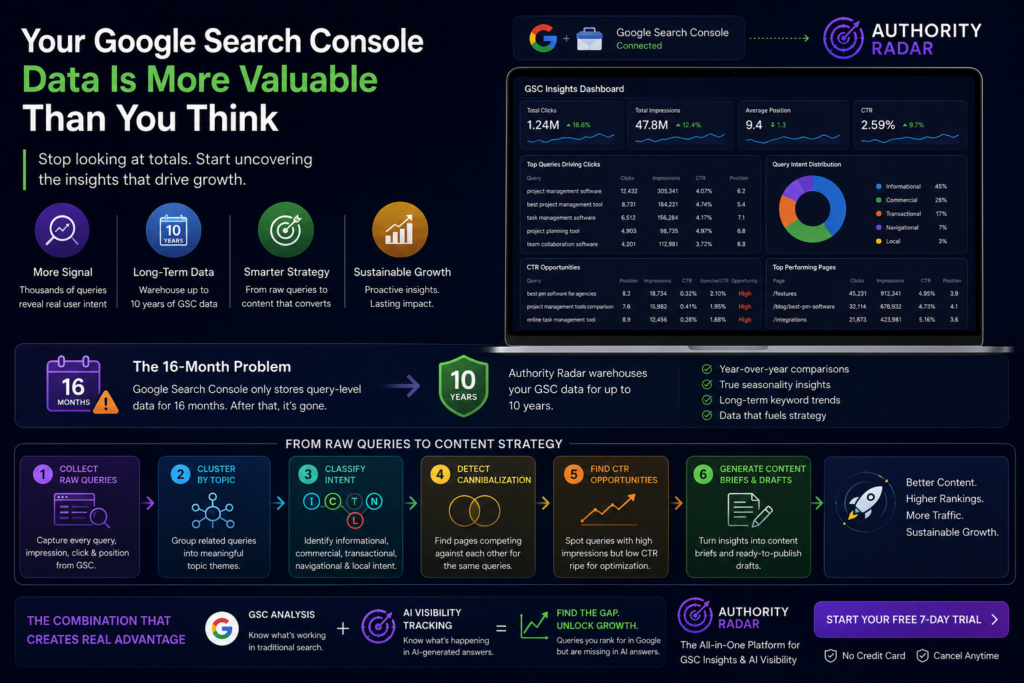
There is also a structural limitation that affects every team using GSC natively: Google only stores query-level data for 16 months. Once that window passes, the data is gone. You cannot compare this October to October two years ago. You cannot see how seasonal patterns have shifted. You cannot do year-over-year analysis on the queries that drive your most important traffic.
This means teams building long-term content strategy on GSC data are working with a fundamentally short-term dataset, and they usually do not realize it until they need historical context and find that the data simply does not exist anymore.
GSC monitoring that warehouses your data for up to 10 years changes this completely. When you have a full historical record, you can do the analysis that actually matters: spotting long-term keyword trends, understanding true seasonality rather than a single year’s noise, and building a content roadmap based on how search demand for your category has genuinely evolved.
From Raw Queries to Content Strategy
The workflow most teams follow with GSC is reactive: something dropped, figure out why. The workflow that actually builds content advantages is proactive: find the patterns in your query data before they become problems or missed opportunities.
That proactive workflow has a few key steps that are difficult to do manually at scale.
Query clustering groups related search terms into meaningful topic themes so you can see that 43 different queries in your dataset all point at the same underlying user question, even though the phrasing varies significantly. This reveals where to focus content investment rather than spreading effort across dozens of superficially different but thematically identical queries.
Intent classification separates informational queries from commercial, transactional, navigational, and local ones. Knowing that a cluster of queries is predominantly commercial-intent tells you the content format and CTA strategy the page needs. Knowing a cluster is informational tells you the success metric is authority, not conversion.
Cannibalization detection finds the pages on your site that are actively competing against each other for the same queries. This is one of the most common and most damaging issues in content-heavy websites, and it is almost invisible without systematic query-level analysis across all your pages simultaneously.
CTR opportunity identification surfaces the queries where your page is ranking in a position that should be generating more clicks than it is. Position 8 with a high impression count and a 0.3 percent CTR is a title tag problem waiting to be fixed, not a ranking problem. Without surfacing these patterns systematically, they remain invisible in the aggregate numbers.
The Authority Radar platform runs this entire workflow automatically: it connects to your Google Search Console via secure OAuth, warehouses your query data with up to 10 years of retention, clusters queries into meaningful topic groups using a multi-level algorithm rather than simple AI-generated clusters, and generates full content briefs and draft content directly from the cluster insights. The pipeline goes from raw queries all the way to a ready-to-publish draft, built on data your site is already generating.
The Combination That Makes the Difference
What makes this particularly powerful is when GSC analysis sits alongside AI visibility tracking in the same platform. Your GSC data tells you what is working in traditional search. Your AI visibility tracking tells you what is happening in AI-generated answers. The gap between the two, queries where you rank well in Google but are absent from AI answers, is where the most actionable content opportunities sit.
If you are not currently warehousing your GSC data or analyzing it at the query-cluster level, you are leaving real content strategy on the table. Start a free 7-day trial and see what your GSC data has been trying to tell you.
