Introduction
Base metals such as copper, zinc, lead, and nickel are essential for modern industries. They are widely used in construction, transportation, electrical systems, renewable energy projects, and manufacturing. As the demand for these metals continues to grow, finding new mineral deposits has become more challenging. Many shallow deposits have already been explored, so today’s exploration projects often focus on deeper and more complex geological areas.
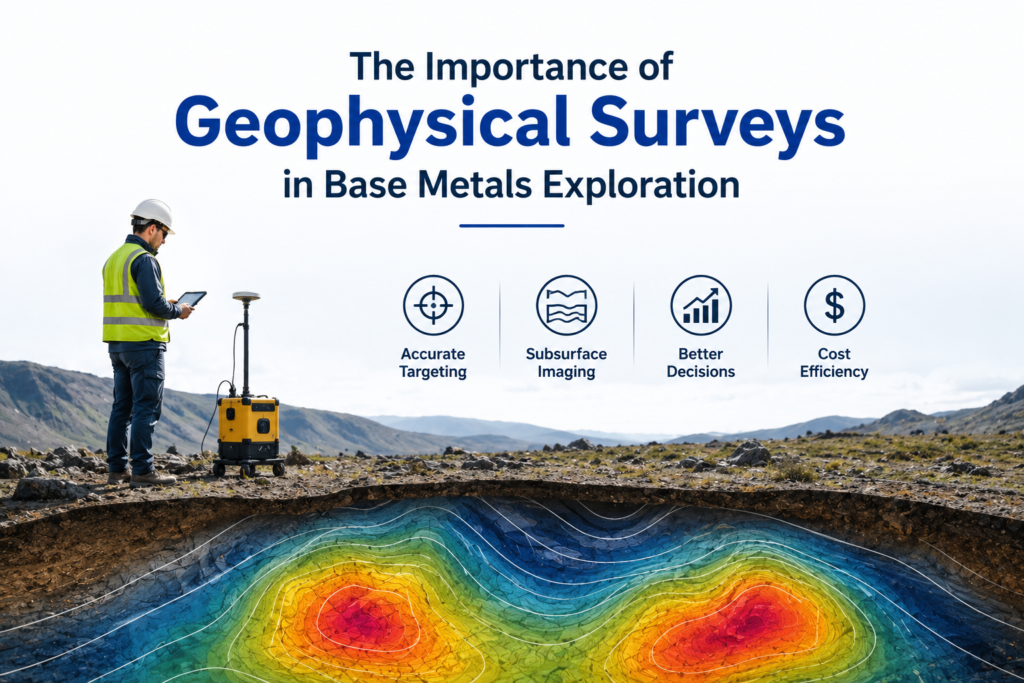
This is where geophysical surveys play an important role. These surveys help exploration teams study what lies beneath the ground without extensive digging. By collecting information about the physical properties of rocks, geophysical surveys help identify areas that may contain valuable mineral deposits.
For companies involved in base metals exploration in Brisbane, geophysical surveys provide reliable information that supports better planning, reduces unnecessary drilling, and increases the chances of making successful discoveries.
What Are Geophysical Surveys?
Geophysical surveys are scientific methods used to study the Earth’s subsurface. Instead of digging large areas, these surveys measure natural physical properties such as magnetism, electrical conductivity, gravity, and seismic waves. Every type of rock has different physical characteristics, allowing geologists to identify changes below the surface.
The collected data helps create a picture of underground geological structures. This information allows exploration teams to understand where mineral deposits may be located before beginning expensive drilling work.
Why Geophysical Surveys Are Important in Base Metals Exploration
Finding base metal deposits is not always easy because many valuable minerals are hidden beneath layers of soil, sediment, or solid rock. Surface observations alone cannot reveal what exists deep underground.
Geophysical surveys help solve this problem by providing useful information about underground rock formations. They identify faults, fractures, rock boundaries, and other geological features that are commonly linked to mineral deposits.
This allows exploration teams to focus on the most promising areas instead of drilling randomly, saving both time and money.
Common Types of Geophysical Surveys
Different types of geophysical surveys are used depending on the exploration area and the type of information required.
| Survey Method | What It Measures | Main Purpose |
| Magnetic Survey | Changes in the Earth’s magnetic field | Maps rock types and geological structures |
| Electromagnetic Survey | Electrical conductivity | Detects conductive mineral deposits beneath the surface |
| Gravity Survey | Differences in rock density | Identifies dense underground rock formations and ore bodies |
| Induced Polarization Survey | Electrical charge storage | Locates sulphide-rich mineral zones |
| Seismic Survey | Movement of sound waves | Creates detailed images of underground rock layers |
Each method provides different information, and combining them often gives the best exploration results.
How Geophysical Surveys Improve Exploration
One of the biggest advantages of geophysical surveys is that they improve exploration accuracy. Instead of selecting drilling locations based only on surface observations, exploration teams can use survey results to identify stronger targets.
Better information leads to better decisions. It also helps create detailed geological models that explain how different rock layers are connected beneath the ground.
As new information becomes available, exploration plans can be updated, making the overall project more efficient.
Reducing Exploration Costs
Drilling is one of the most expensive parts of any mineral exploration project. Drilling in the wrong location can result in wasted time and higher project costs.
Geophysical surveys reduce this risk by helping teams identify areas with higher mineral potential before drilling begins. Although the surveys require specialized equipment, they often lower total exploration costs because fewer unnecessary drill holes are needed.
This makes exploration projects more cost-effective and improves the use of available resources.
Environmental Benefits of Geophysical Surveys
Modern exploration aims to reduce environmental disturbance whenever possible. Geophysical surveys support this goal because they require very little ground disturbance compared to large-scale excavation.
Some important environmental benefits include:
- Less digging during the early stages of exploration.
- Reduced impact on vegetation and surrounding land.
- Smaller environmental footprint compared to traditional exploration methods.
- Better planning before carrying out drilling activities.
- Improved use of exploration resources with fewer unnecessary operations.
These advantages help companies carry out exploration more responsibly while protecting the surrounding environment.
Exploring Deeper Mineral Deposits
Many of today’s mineral discoveries are located much deeper than older deposits. Thick soil cover and complex geological conditions often hide these resources from traditional exploration methods.
Geophysical surveys allow exploration teams to investigate these deeper areas by measuring changes in underground rock properties. This makes it possible to identify mineral targets that cannot be seen from the surface.
As exploration technology continues to improve, deeper discoveries are becoming more achievable.
Combining Geophysical Surveys with Other Exploration Methods
Geophysical surveys provide valuable information on their own, but they become even more useful when combined with other exploration techniques.
Geologists often use several methods together because each one provides different information about the subsurface. By combining these results, they develop a much clearer understanding of the exploration area and increase the chances of locating valuable mineral deposits.
This integrated approach helps reduce uncertainty throughout the exploration process.
The Role of Modern Technology
Technology has greatly improved the quality of geophysical surveys over the past several years. Modern instruments collect more accurate data and cover larger areas in less time than older equipment.
Digital processing systems also allow experts to analyze information more quickly and create detailed underground maps that support exploration planning.
These improvements help exploration teams make better decisions while increasing the overall success of exploration programs.
Key Benefits of Geophysical Surveys
Geophysical surveys offer several important advantages during base metals exploration.
Some of the major benefits include:
- Improve the accuracy of exploration targets.
- Reduce unnecessary drilling expenses.
- Provide detailed information about underground geology.
- Support safer and more efficient exploration planning.
- Minimize environmental disturbance.
- Help discover deeper mineral deposits.
- Improve confidence before making major investment decisions.
These benefits make geophysical surveys one of the most valuable tools used during modern mineral exploration.
Challenges of Geophysical Surveys
Although geophysical surveys provide valuable information, they cannot directly confirm the presence of minerals. The collected data must be carefully interpreted by experienced professionals.
Different rock types can sometimes produce similar survey results, making interpretation more complex. For this reason, geophysical surveys are usually combined with geological mapping, sampling, and drilling to confirm exploration targets.
Using multiple exploration methods together provides more reliable results than depending on a single technique.
Why Geophysical Surveys Are Important for the Future
As industries continue to require more base metals, exploration projects must search in increasingly challenging geological environments. Geophysical surveys provide the detailed underground information needed to locate new mineral resources more efficiently.
For businesses involved in base metals exploration in Brisbane, these surveys help improve project planning, reduce financial risks, and support responsible exploration practices. Their importance will continue to grow as exploration moves toward deeper and more complex mineral systems.
Summary
Geophysical surveys have become an essential part of modern base metals exploration. They help exploration teams understand underground geology, identify promising mineral targets, and reduce unnecessary drilling before major investments are made.
By providing accurate information about subsurface conditions, these surveys improve exploration efficiency while lowering costs and reducing environmental impact. When combined with geological studies and drilling, geophysical surveys create a complete picture of the exploration area and increase the chances of successful mineral discoveries.
As exploration continues to evolve, geophysical surveys will remain one of the most reliable and effective tools for discovering future base metal resources.
Frequently Asked Questions
1. Why are geophysical surveys important in base metals exploration?
Geophysical surveys help identify underground geological structures and possible mineral deposits before drilling begins. They improve exploration accuracy, reduce unnecessary expenses, and allow exploration teams to focus on the areas that have the greatest potential for successful mineral discoveries.
2. Can geophysical surveys replace drilling?
No. Geophysical surveys provide valuable information about underground conditions, but they cannot confirm the presence of minerals on their own. Drilling is still necessary to collect rock samples and verify whether economically valuable mineral deposits actually exist.
3. Which geophysical survey method is most commonly used?
There is no single method that works for every project. Magnetic, electromagnetic, gravity, induced polarization, and seismic surveys are all commonly used. The best choice depends on the geological conditions and the type of mineral deposit being explored.
4. Are geophysical surveys environmentally friendly?
Yes. Geophysical surveys usually have a much smaller environmental impact than large-scale excavation or trenching. They allow exploration teams to collect important underground information while causing minimal disturbance to the land and surrounding natural environment.
5. How do geophysical surveys support base metals, Exploration Brisbane?
For base metals exploration in Brisbane, geophysical surveys help identify promising exploration targets, improve planning, lower drilling risks, and provide reliable geological information. This leads to more efficient exploration programs and increases the likelihood of discovering economically valuable mineral deposits.
