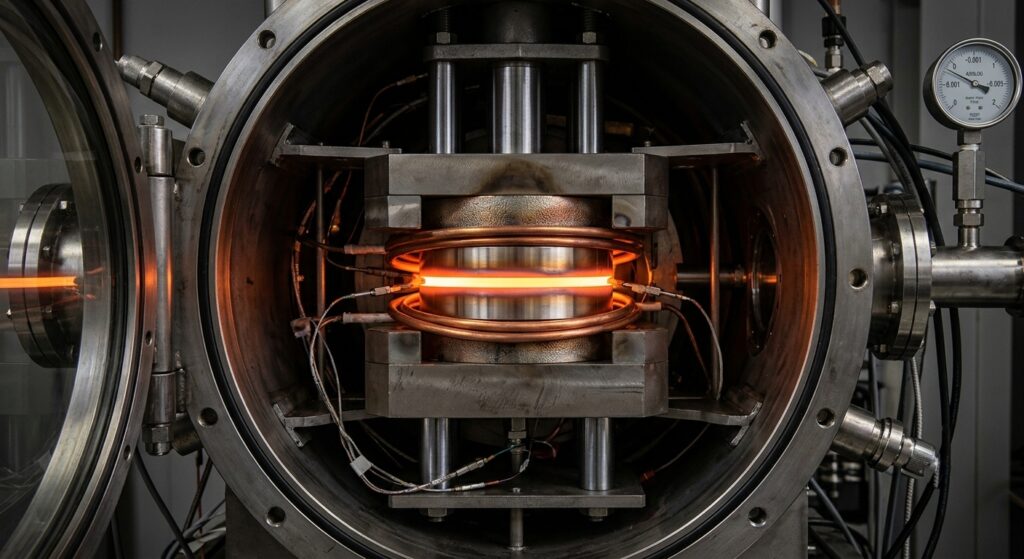
When engineers hear “vacuum brazing,” many assume it’s a single, uniform process. In reality, the vacuum brazing world splits into distinct pressure regimes and the difference between standard vacuum brazing and ultra-high vacuum (UHV) brazing can mean the difference between a joint that’s “good enough” and one that meets the hermetic, contamination-free standards required for aerospace, semiconductor, or medical-grade components.
If you’re specifying a brazed assembly for a high-reliability application, understanding this distinction isn’t academic it directly affects cost, lead time, material selection, and whether your part will actually perform in the field.
What Is Vacuum Brazing?
Vacuum brazing joins metal components by melting a filler metal inside a sealed chamber from which most of the air has been evacuated. Removing atmospheric oxygen prevents oxidation at the joint, eliminates the need for corrosive flux, and produces clean, strong, repeatable joints even between dissimilar metals that are difficult to weld conventionally.
Standard vacuum brazing furnaces typically operate in the high-vacuum range, roughly 10⁻³ to 10⁻⁶ torr during the actual braze cycle. That’s more than sufficient to suppress oxidation on common engineering alloys like stainless steel, nickel alloys, copper, and aluminum, and it’s the workhorse process behind the vast majority of brazed heat exchangers, tubing assemblies, and structural joints produced today.
What Is Ultra-High Vacuum (UHV) Brazing?
Ultra-High Vacuum Brazing pushes the process into a far more rarefied environment pressures from about 10⁻⁶ down to 10⁻⁹ torr, sometimes lower. At that level, the number of residual gas molecules in the chamber drops by several orders of magnitude compared to standard vacuum brazing.
This isn’t just “more of the same vacuum.” It requires different pumping systems (often turbomolecular or ion pumps layered on top of diffusion or mechanical pumps), different chamber materials and seals to avoid outgassing, and much tighter process control over heat-up and cool-down cycles. The payoff is a processing environment clean enough for applications where even trace contamination or a few parts-per-million of residual oxygen can compromise performance.
The Core Differences at a Glance
| Factor | Standard Vacuum Brazing | Ultra-High Vacuum (UHV) Brazing |
| Typical pressure range | ~10⁻³ to 10⁻⁶ torr | ~10⁻⁶ to 10⁻⁹ torr |
| Primary goal | Prevent oxidation, eliminate flux | Achieve near-total contamination control |
| Equipment | Diffusion/mechanical pump systems | Turbomolecular/ion pumps, specialized chambers |
| Typical materials joined | Stainless steel, nickel alloys, copper, aluminum | Reactive/refractory metals, ceramics, specialty alloys sensitive to trace gases |
| Common industries | Aerospace, automotive, HVAC, general industrial | Semiconductor, photonics, medical implants, fusion/defense research |
| Relative cost & cycle time | Lower cost, faster cycles | Higher cost, longer pump-down and process cycles |
Why the Vacuum Level Actually Matters
The pressure level isn’t an arbitrary spec it’s tied directly to metallurgy. Every metal has a vapor pressure: a temperature and pressure combination at which it begins to volatilize inside the chamber. Elements like zinc, cadmium, and even chromium (a key component of stainless steel) can begin to outgas at brazing temperatures if the vacuum is pulled too hard relative to what the base metal and filler alloy can tolerate. That outgassing can cause voids in the joint and contaminate the furnace itself.
This is why experienced brazing engineers often talk about using “the weakest vacuum you can get away with” for standard work going deeper than necessary adds cost and risk without adding benefit. UHV brazing is reserved for applications where that deeper vacuum is genuinely required not as a default, but as an engineering necessity.
Where Each Process Fits
Standard vacuum brazing is the right call for the majority of applications: automotive and aerospace heat exchangers, transmission coolers, fluid assemblies, and general structural joints where oxidation control and joint strength are the priority.
UHV brazing earns its higher cost in applications where:
- Semiconductor and electronics packaging requires hermetic seals with virtually no trapped gas or moisture that could later outgas and damage sensitive components.
- Medical implants and surgical instruments demand biocompatible, contamination-free assemblies that will spend years inside the human body.
- Photonics and hermetic feedthroughs need joints stable enough to preserve optical or electrical performance over the life of the device.
- Fusion energy and advanced defense research push materials into extreme thermal and cryogenic cycles where even trace impurities can affect component life.
A Growing Distinction, Not a Niche One
As demand accelerates for hydrogen infrastructure, fusion energy pilots, and next-generation semiconductor packaging, more manufacturers are being asked to specify UHV-grade brazing where standard vacuum brazing used to suffice. Choosing the wrong process or a shop that can’t reliably hold true UHV pressures can mean field failures that are expensive to trace back to a joint that looked fine on inspection but wasn’t clean enough at the molecular level.
Choosing the Right Partner
Because the difference between these two processes comes down to equipment capability, process control, and decades of applied metallurgical know-how, the choice of brazing partner matters as much as the choice of process.

Really solid breakdown of the pressure ranges. We switched from standard vacuum brazing to UHV for a semiconductor packaging project last year and the outgassing issue you mentioned was exactly what pushed us there — standard vacuum just couldn’t hold the contamination levels our client needed. The “weakest vacuum you can get away with” point is something more shops should emphasize instead of upselling UHV by default.
Thanks Jack
Great comparison table — clears up a lot of confusion. Question though: for medical implants specifically, is UHV always required, or does it depend on the alloy? Been reading conflicting info on titanium vs cobalt-chrome brazing requirements.
Thanks Mary
This is a helpful explainer for someone like me who isn’t an engineer but has to make procurement decisions. The cost/cycle time comparison at the end of the table was exactly what I needed to justify the budget difference to my team. Would love a follow-up post on how to actually vet a brazing partner’s UHV capabilities before signing a contract.
Thanks haydon