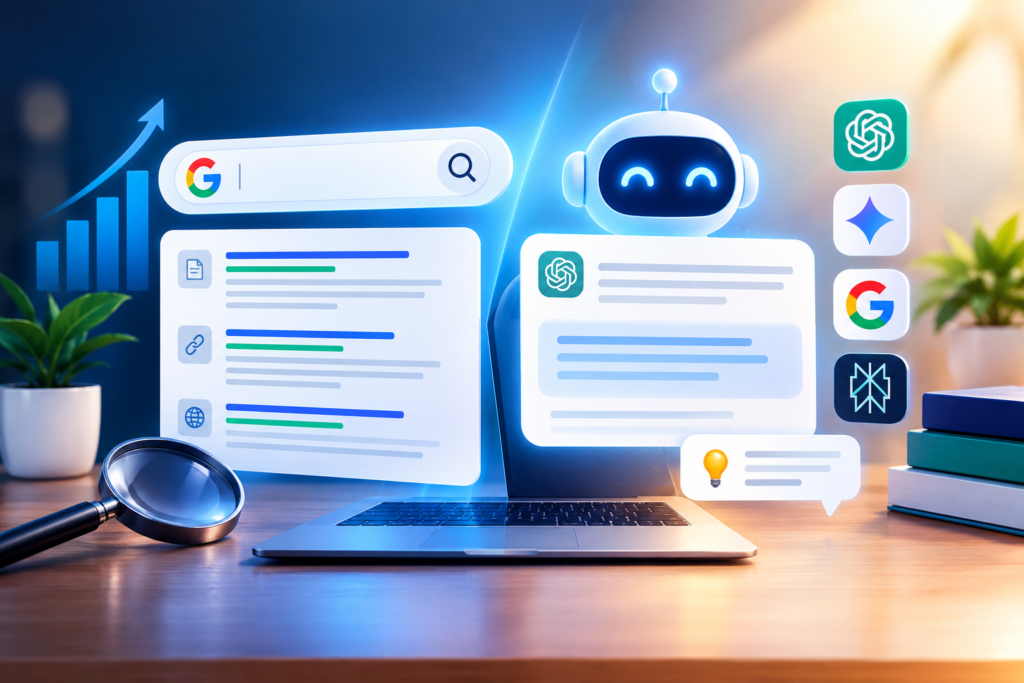
Search has changed. People now type a question into Google and get a written answer before they see a single blue link. They ask ChatGPT, Perplexity, or Gemini for a recommendation and act on it without ever visiting a website. If your content isn’t the source those tools quote, you’re losing visibility even when you “rank.”
That is why Answer Engine Optimization (AEO) has become one of the most searched topics in digital marketing. In this guide, we explain how AEO differs from traditional SEO, what needs to change in your strategy, and how to start earning citations in AI-generated answers.
What Is Answer Engine Optimization (AEO)?
Answer Engine Optimization is the practice of structuring and strengthening your content so AI-powered platforms can understand it, trust it, and cite it as the answer to a user’s question. These platforms include Google AI Overviews, ChatGPT search, Perplexity, Microsoft Copilot, and voice assistants.
Traditional SEO asks, “How do I get my page to rank on page one?” AEO asks, “How do I become the answer?”
Both disciplines share the same foundation: quality content, technical health, and authority. The difference is in how that content is packaged and proven.
AEO vs SEO: The Key Differences
| Factor | Traditional SEO | Answer Engine Optimization |
| Goal | Rank in the list of results | Be cited inside the answer |
| Success metric | Rankings, clicks, traffic | Citations, mentions, brand visibility |
| Content style | Keyword-targeted pages | Direct, question-led, entity-rich answers |
| Query type | Short keywords | Long, conversational questions |
| Authority signals | Backlinks, domain authority | Backlinks plus brand mentions, expertise, consistency across the web |
| Format | Long-form pages | Scannable blocks: definitions, lists, tables, FAQs |
The takeaway: AEO doesn’t replace SEO. It builds on it. Pages that AI systems cite almost always come from sites that already have strong technical foundations and topical authority.
What Needs to Change to Rank in AI Search
1. Lead with the answer
AI systems pull concise, self-contained passages. Put a clear 40 to 60 word answer directly under each question-style heading, then expand with detail. Don’t bury the point under a long introduction.
2. Write for questions, not just keywords
Conversational queries like “How do I rank in AI Overviews?” are replacing fragmented keywords. Build content around the full journey: what it is, how it works, how much it costs, and which option is best. This is where semantic SEO matters. Cover related entities and subtopics (structured data, E-E-A-T, topical authority, featured snippets, voice search) so machines see your page as a complete resource.
3. Strengthen E-E-A-T
Experience, Expertise, Authoritativeness, and Trustworthiness matter more than ever, because AI models avoid citing unreliable sources. Add named authors with credentials, cite credible data, publish original insights or case studies, and keep content updated with visible dates.
4. Use structured data
Schema markup (FAQPage, Article, HowTo, Organization, Product, LocalBusiness) helps machines interpret your content without guessing. It’s not a magic switch for AI citations, but it removes ambiguity and supports eligibility for rich results.
5. Build entity authority beyond your site
AI models learn about brands from the whole web: reviews, directories, news mentions, forums, and industry publications. Keep your brand name, description, and services consistent everywhere. Earn mentions on relevant, reputable sites, not only links.
6. Fix the technical basics
If crawlers can’t access your content, AI can’t cite it. Make sure your pages are indexable, fast, mobile-friendly, and use clean heading structure. Review your robots.txt so you aren’t unintentionally blocking the crawlers you want to be visible to.
7. Format for scanning
Use short paragraphs, descriptive H2 and H3 headings, bullet lists, comparison tables, and step-by-step instructions. Structured content is easier for both readers and language models to extract.
A Simple AEO Checklist
- Answer the main question in the first 50 words of each section
- Use question-based H2 and H3 headings
- Add an FAQ section with schema markup
- Show author names, credentials, and update dates
- Include original data, examples, or expert quotes
- Keep NAP (name, address, phone) and brand details consistent online
- Monitor brand mentions in ChatGPT, Perplexity, and Google AI Overviews
Should You Hire Experts for AI Search?
AEO is new enough that many businesses struggle to know where to start. Working with a specialist SEO services company can speed things up, especially if you lack time to restructure content, implement schema, and build off-site authority.
When comparing providers, look for teams that:
- Treat AEO as an extension of SEO, not a replacement
- Offer transparent reporting that includes AI visibility, not only rankings
- Can show real case studies and measurable results
- Don’t guarantee a specific position (nobody legitimately can)
If you’re searching for the best SEO company for your needs, ask how they approach AI search, content quality, and link building. Agencies like SEO Inferno combine traditional optimization with modern AI SEO services, helping brands adapt content, technical setup, and authority signals so they stay visible in both classic results and AI-generated answers.
Frequently Asked Questions
1. What is Answer Engine Optimization (AEO)?
Answer Engine Optimization is the process of optimizing content so AI platforms and answer engines can find, understand, and cite it in direct responses. It focuses on clear answers, structured data, and trustworthy authority signals.
2. Is AEO replacing SEO?
No. SEO remains the foundation, since AI systems rely heavily on pages that are already crawlable, authoritative, and well ranked. AEO adds a layer focused on being quoted, not just listed.
3. How do I rank in Google AI Overviews and ChatGPT?
Provide direct, accurate answers; use question-based headings; add schema markup; demonstrate expertise with real authors and sources; and build brand mentions across trusted sites. No tactic guarantees inclusion, but these steps improve your chances.
4. What are AI SEO services?
AI SEO services help businesses optimize for both traditional search engines and AI-driven platforms. They typically include content restructuring, entity and schema optimization, technical audits, authority building, and tracking AI visibility.
5. How do I choose the best SEO company for AI search?
Choose a team with proven results, transparent reporting, and a clear AEO strategy. Ask for case studies, avoid anyone promising guaranteed rankings, and confirm they understand both SEO and AI search behavior.
Final Thoughts
The shift from rankings to answers doesn’t mean SEO is dead. It means the standard has risen. To succeed with Answer Engine Optimization, give clear answers, prove your expertise, structure your content for machines and humans, and build a trusted brand presence across the web.
Start by updating your highest-value pages: add direct answers, FAQs, and schema, and strengthen your authorship signals. If you’d rather have experts handle it, SEO Inferno can help you build a strategy that performs in traditional search and in AI search.
